At 14:28 UTC on September 6, 2026, the federation behind Blockstream's Liquid sidechain released 3,996 BTC, about $320 million at Sunday's prices and 95 percent of its reserves. The coins left against L-BTC that a bug in Elements let someone mint from nothing. Blockstream paused the sidechain. The holder claims to be a white hat and had returned nothing by Monday morning.
The drain used a legitimate exit. At 14:05 UTC someone submitted 4,000 L-BTC to the peg-out portal run by SideSwap, one of Liquid's approved exit points, according to CryptoTicker's reconstruction. The federation's 11-of-15 multisig then did what it is built to do and sent 3,996 BTC to an external bitcoin address, confirmed in block 965,783. Protos counted 83 inputs, each spent with the 11 valid signatures the arrangement requires.
The Block reported that the coins were about 95 percent of the approximately 4,200 BTC backing every L-BTC in circulation. The reserve page at liquid.network showed 4,205 L-BTC outstanding against 197 BTC held by the time anyone noticed. That is under 5 percent backing for a token pitched as 1:1.
Liquid posted on X that it was aware of a security incident and that neither the SideSwap peg-out authorization key nor any other key had been compromised. It disabled the bridge nodes so no new transactions could be submitted and asked exchanges to suspend L-BTC deposits and withdrawals. Blockstream's status page says the sidechain is effectively paused until the issue is resolved.
Submitted through SideSwap, minted by an Elements bug.
11 of 15 federation signatures on 83 inputs.
Sidechain paused, exchanges asked to freeze L-BTC.
Whitehat claim, fix-first demand, PGP-signed reply.
Promise covers most of the coins, no deadline.
An Elements bug, not a stolen key
Blockstream attributed the L-BTC to a bug in Elements, the open-source codebase Liquid runs on. SideSwap called it faulty L-BTC originating from a third-party Elements bug. That is worse than a stolen key: the federation signed a legitimate peg-out for coins that should never have existed, and every signer's software agreed they did.
Independent analysis relayed by CryptoTicker points to a consensus-level flaw in how Elements cached confidential transaction rangeproofs, the proofs that keep amounts hidden while showing they are valid. The cache key left out the asset and script context. A proof verified once could be reused where it should have failed, and unbacked L-BTC could be created and accepted by a subset of nodes.
CryptoTicker reported that a fix had been merged into the Elements repository but not shipped in a tagged release. Protos could not confirm which commit was exploited and flagged a September 1 validation fix for dynafed headers as a candidate. It also quoted Casa's Jameson Lopp, who observed that the Liquid functionary codebase appears not to have been touched in two years and did not consider that a good sign. Blockstream had not published a technical post-mortem as of Monday.
A negotiation conducted in OP_RETURN
Shortly after the peg-out confirmed, the receiving address broadcast an OP_RETURN message, a short note embedded in a bitcoin transaction. It read in full: "we are whitehats. contact us on chain."
Blockstream answered at block 965,822 with security contact information, CryptoTicker reported, and a second address offered a Signal handle, Protos reported. At block 965,875 the taker set terms, The Block reported: fix the bug first, make sure every node is patched, and the money comes back once the fix is confirmed. Blockstream then sent a PGP-signed on-chain message, verifiable against the security key on its website: "Bridge nodes are patched, safe to return the funds."
As of Monday morning nothing had moved. Protos put the balance in the taker's address at 3,998 BTC.
Bitcoin.com reported three further details. The taker's later wording promised to return "most" of the funds rather than all, with no deadline. An unsigned on-chain message offering a 98 BTC bounty also appeared and may have come from an impersonator. And Blockstream CEO Adam Back had not posted about the matter personally, leaving the status page and the on-chain messages as the company's only public statements a full day after the drain.
We would treat the white hat label as a claim until the coins are back. Real white hats generally do not take 95 percent of a reserve to prove a point, and "most" leaves room for a very large finder's fee.
Liquid is a settlement layer for exchanges and financial firms, according to The Block. Blockstream lists Bitfinex and BTSE among its users, and L-BTC is the collateral for a good deal of confidential over-the-counter flow. Every one of those holders now owns a claim on a reserve that is under 5 percent funded, pending a stranger's goodwill.
Other assets issued on Liquid, including USDT, DePix and tokenized real-world assets, were not affected by the bug, Blockstream's status page said. They are frozen with everything else until the network restarts, and no restart timeline has been published. Bitcoin's base layer was untouched.
This is the second nine-figure bitcoin security failure in a month, after the Coldcard entropy exploit. The lesson is the one our security basics guide keeps repeating: any layer between a holder and the base chain, whether a wrapped token, a bridge or a federation, is a counterparty, and counterparties fail.
The Crypto Times tallied $322 million in publicly reported exploits for September 1 to 7, and Liquid is about 99 percent of it.
The market barely flinched, for now
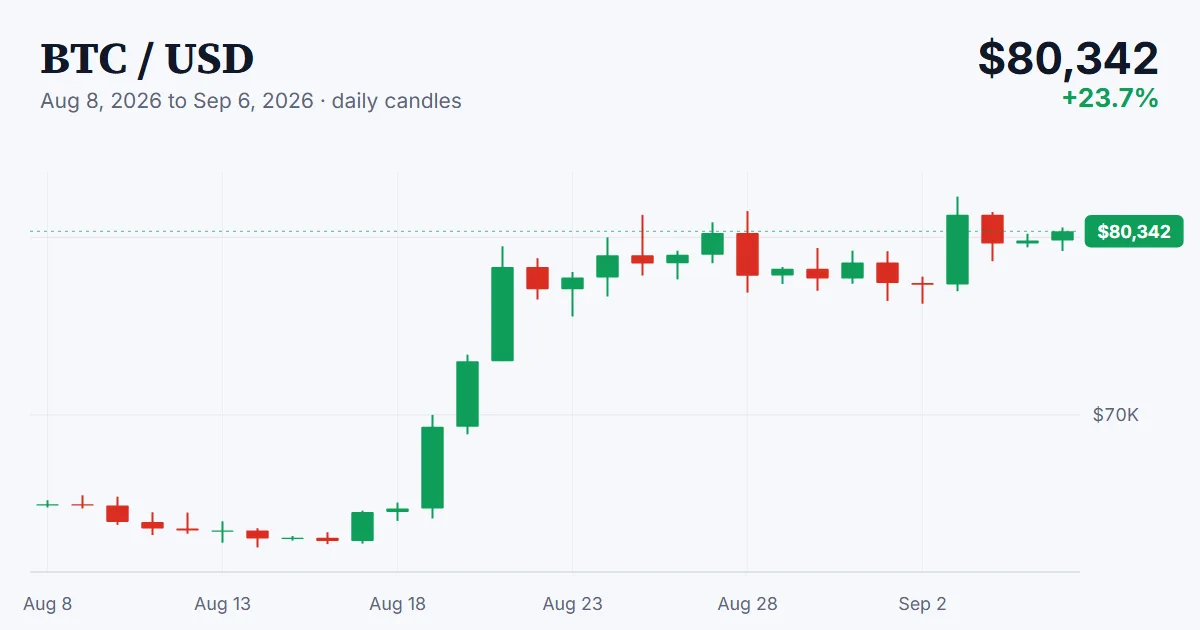
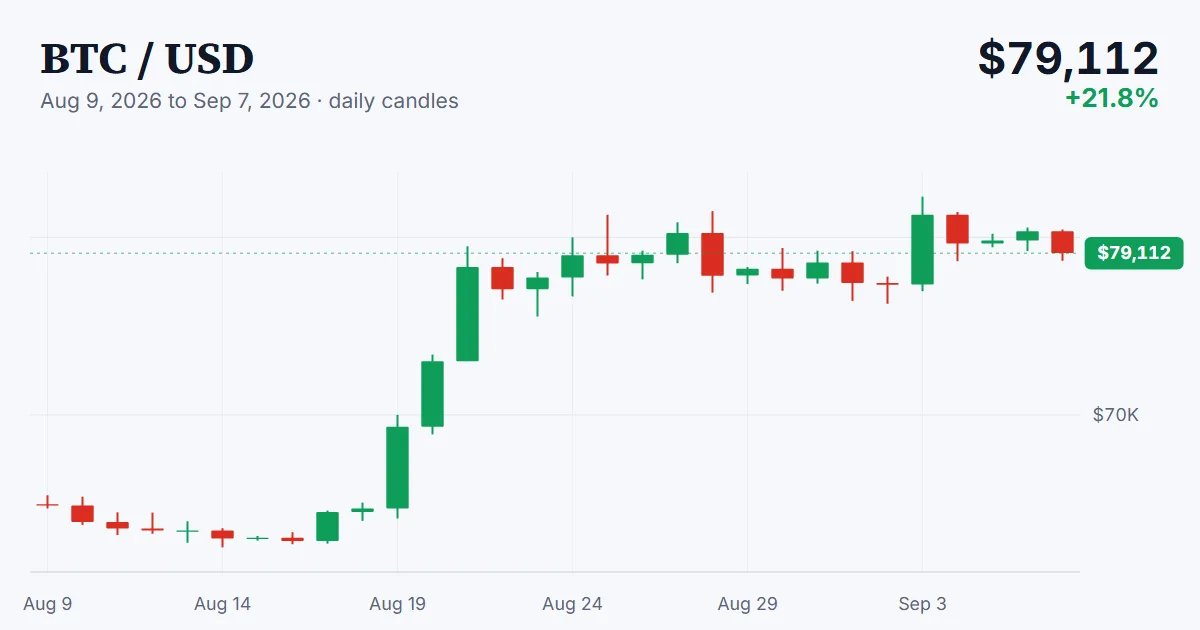
The drain landed on a market already leaning cautious, and the price reaction was small. Bitcoin opened Monday at $80,351, 0.7 percent above Sunday's open, then slipped to $79,350 by 9:41 a.m. ET, Yahoo Finance reported. It framed the week as a rate watch ahead of the August CPI and PPI prints that Fed officials have named as the deciding inputs for the September 15 to 16 meeting.
CoinDesk's Monday read had bitcoin down 1.3 percent since midnight UTC while the weekend's altcoin push faded. Bittensor, Kaspa, Internet Computer and Celestia had each gained more than 12 percent over 24 hours, most of it before midnight, and were handing part of it back.
Positioning is the more telling number. Futures open interest fell to 670,000 BTC from 709,000 on Friday, the lowest since March 23, CoinDesk reported. The taker buy-sell ratio leaned short at 51.6 percent, a reversal from Friday's bullish reading.
Leverage was already leaving before the Liquid headline, which is one reason a $320 million loss at a sidechain did not trigger forced selling. The coins did not hit the market, and the traders most likely to panic had largely deleveraged into Friday's jobs shock.
Two things would change that. The first is the 3,998 BTC moving anywhere other than back to the federation: a sale of that size into a thinning order book would be felt, and a partial return would show the finder's fee. The second is the post-mortem, which will show whether other Elements-based deployments share the same cache bug, and so whether this was a Liquid problem or a class of problem.
We will update this page when the coins move, when Blockstream publishes its technical account, or when the sidechain restarts. Nothing here is trading advice, and L-BTC holders on an exchange should read that exchange's own notice rather than anyone's thread.