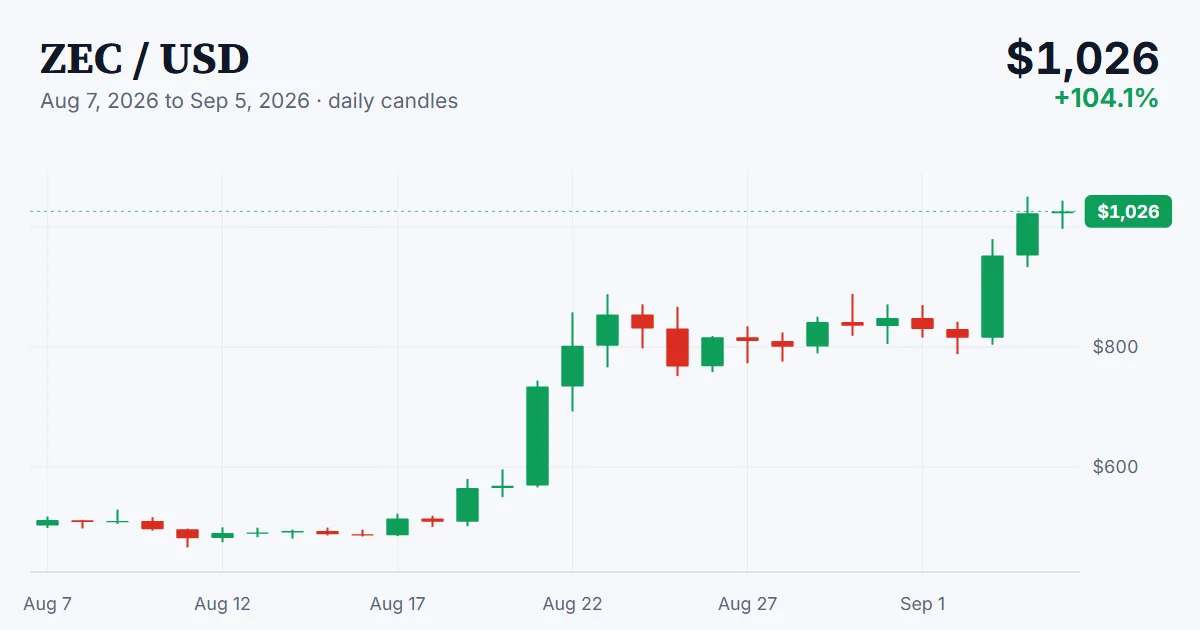
Zcash traded at $1,023 on Friday, September 4, 2026, its first print above $1,000 in nearly a decade. IBTimes reported that ZEC opened the day near $828 and gained about 20 percent in 24 hours. IBTimes and Gokhshtein counted roughly $36.6 million of liquidated ZEC positions, $34.5 million of them shorts.
Zcash was a $150 coin last November. A day before the $1,023 print, FXStreet had logged a 16 percent rise to what was then a record $979. The coin is up about 94 percent in a month and more than 2,300 percent in a year. Coingape put its market capitalization at $16.8 billion, tenth among all cryptocurrencies, and IBTimes noted that ZEC had pushed Dogecoin out of the top ten.
How the squeeze built
One position drew most of the attention. IBTimes reported that on-chain trackers tied a wallet to Garrett Jin, a former BitForex executive, holding a 32,760 ZEC short entered near $444. At $1,000 that short was underwater by more than $18.5 million on a position worth about $33 million at market. We repeat the attribution as reported and have not verified who controls the wallet.
Coingape's derivatives data shows why the pressure was one-sided. Open interest in ZEC futures had climbed 42 percent to $2.33 billion. The long-short ratio was 0.60 on Binance and 0.37 on OKX, so shorts outnumbered longs by a wide margin on both venues going into Friday. A crowded short in a rising market is vulnerable: liquidated shorts must buy back, and that forced buying pushes the price up faster.
Why the two-week-old ETF matters more than the squeeze
The liquidations drove the speed of the move, but the demand underneath them has a clear source. In late August Grayscale converted its Zcash Trust into ZCSH, a spot ETF listed on NYSE Arca, IBTimes reported. It is the first US spot exchange-traded fund holding a privacy coin. Coinbase is the custodian and BNY Mellon the administrator. Two weeks after listing, Coingape and IBTimes said, the fund had gathered about $414 million in net assets.
That is small next to the $731 million that bitcoin ETFs took in on a single day this week. It is still a new source of demand for a coin that shorts had been betting against. An ETF also widens who can own the asset: advisers, retirement accounts and funds that cannot hold a coin directly can buy a ticker instead.
Grayscale's head of research, Zach Pandl, tied the rally to a hard money thesis, Coingape reported. He argued that ZEC could reach roughly $8,100 if it captured 10 percent of bitcoin's market value, up from about 0.1 percent today. We quote it because it is driving positioning, not because we endorse it. A 100-fold gain in market share is a thought experiment, and the same arithmetic produces any number you like.
What is measurable is narrower: a fixed 21 million maximum supply, a fund that gathered $414 million in two weeks, and a short base that lost money as the price rose. Those three facts explain a $1,000 print without any forecast.
First US spot ETF for a privacy coin; $414M in two weeks.
Open interest $2.33B, long-short 0.60 on Binance, 0.37 on OKX.
Forced buying carries ZEC from $828 to $1,023.
Coingape flags $1,400 as the next resistance and overbought readings.
What to watch from here
A coin that last traded this high nearly a decade ago has just run the script that new tokens try to follow: a regulated wrapper, a supply story, a crowded short and a squeeze. The difference is that Zcash's supply schedule is public and finished. That is why our tokenomics guide uses fixed-cap coins as the baseline for judging unlock-heavy launches.
Coingape's technical read has $1,400 as the next resistance, at the 61.8 percent Fibonacci level. Its relative strength index, a momentum gauge, stands at 73, which says the coin is already stretched. Squeezes end when the forced buying runs out, and a coin up 94 percent in a month carries large gains that holders may sell, whether or not the thesis holds.
Two things would change our reading. Sustained ZCSH inflows on Farside or Grayscale's own reporting would show that the ETF bid, not the liquidation cascade, is the driver. A second US issuer filing for a Zcash product would show that privacy coins have moved from tolerated to competed for. Until one of those appears, our reading is that $1,000 came from forced buying against real but modest fund demand, and the number to track is the fund's daily flow, not the price.