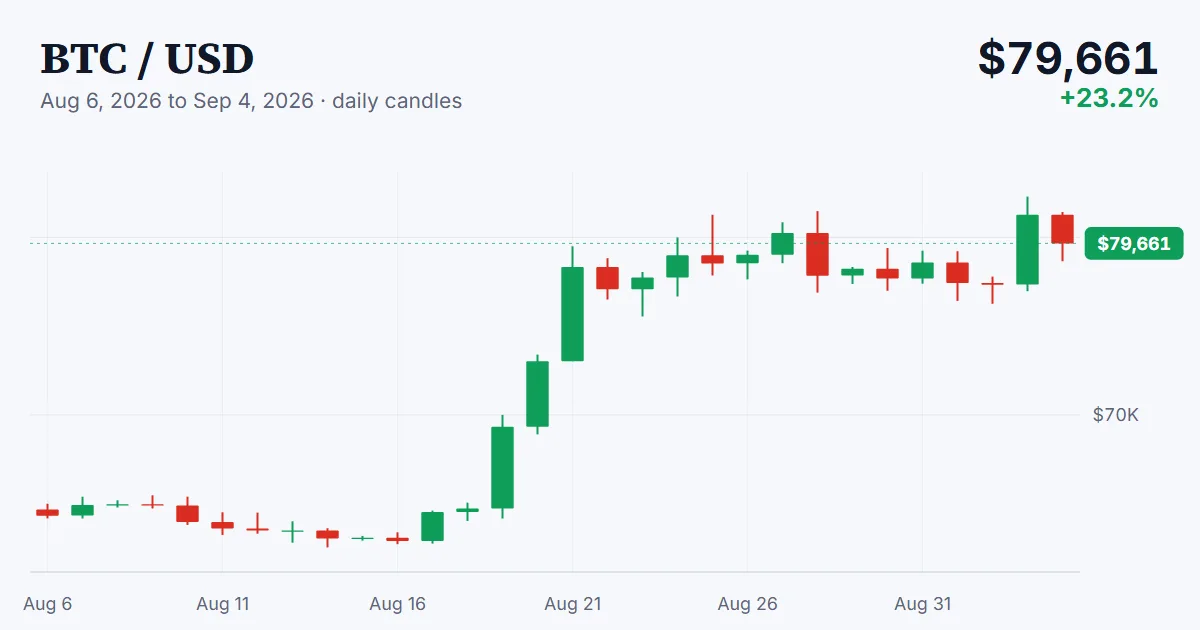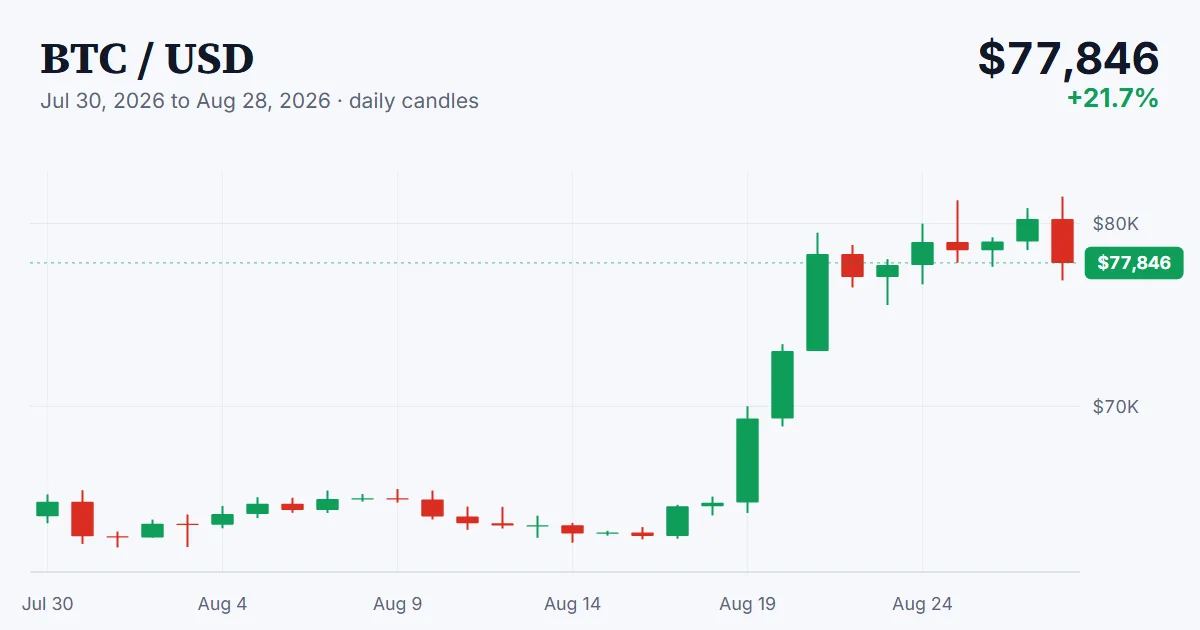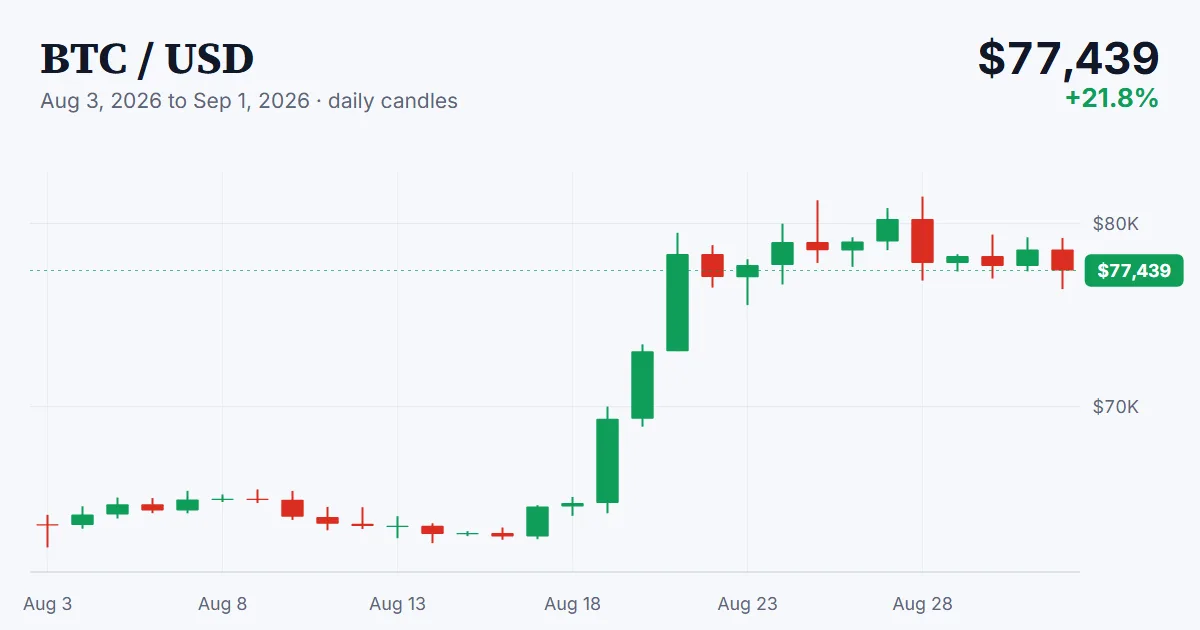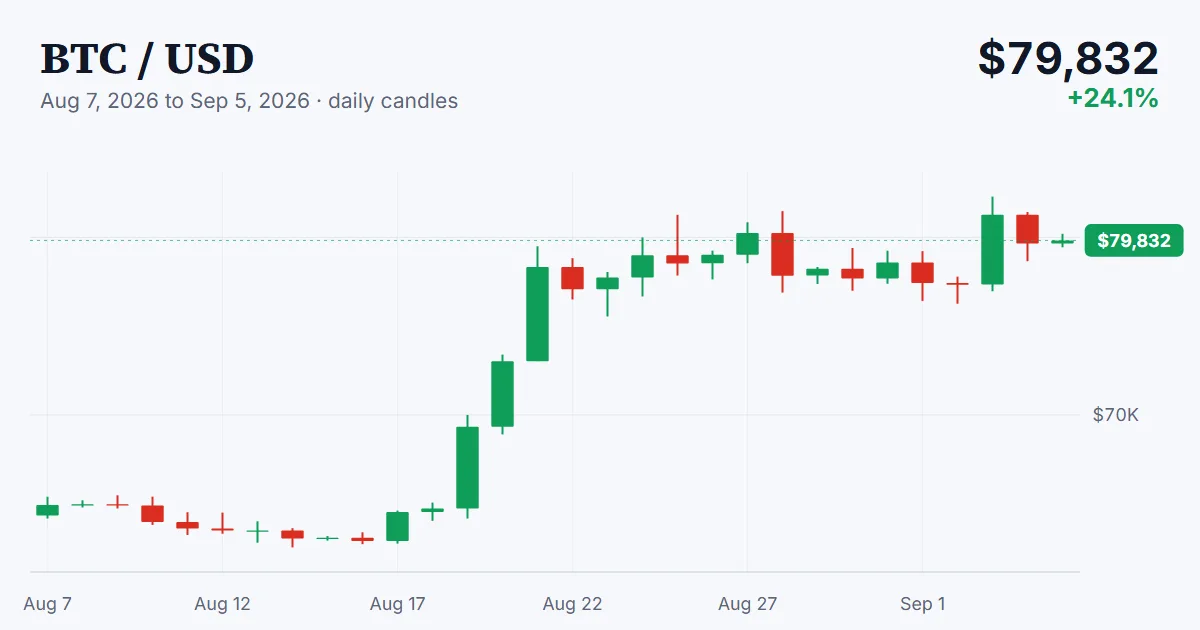
On Thursday we wrote that the ETF complex had not yet voted on the Waller rally, because flows publish a day late. Friday's print settled it. US spot bitcoin ETFs took in $730.89 million net on September 3, 2026, per Trader T data relayed by KuCoin and TechFlow, and both Coinotag and Bitget News called it the largest single-day inflow since January 14. Yahoo Finance framed the same number as the best day in nine months. Whichever calendar you use, the scale is what matters: the previous two sessions had produced a $236.5 million outflow and a $101.1 million inflow, so Thursday alone was worth roughly seven times Wednesday and turned the first three days of September into a $595 million net positive, per BeInCrypto's tally. That is the flow response to a Fed governor saying he would back a September hold, and it arrived through the largest, most institutional pipe the asset has.
The distribution was lopsided in the usual direction. BlackRock's IBIT accounted for $453.96 million, about 62 percent of the day, with ARK Invest's ARKB at $137.74 million, Fidelity's FBTC at $74.45 million, Grayscale's Bitcoin Mini Trust at $48.79 million and Bitwise's BITB at $24.76 million, per KuCoin. Two funds went the other way: VanEck's HODL lost $19.58 million and WisdomTree's BTCW $5.16 million. Combined net assets across the complex reached $103.34 billion, which Coinotag put at about 6.32 percent of bitcoin's total market capitalization. The last time we logged a stretch in this range was the August streak that pulled in $3 billion over eight sessions, and even then no single day cleared $700 million.
Ether funds turned around on the same day
The rotation we described on Thursday lasted exactly one session. US spot ether ETFs recorded $141.39 million of net inflows on September 3, per Bloomingbit and KuCoin, a day after a $48 million outflow had ended the twelve-session, $1.62 billion streak. BlackRock's ETHA led with $72.07 million and Fidelity's FETH was close behind at $65.11 million, which together is nearly the whole number. Invesco's QETH added $5.39 million, Grayscale's Ethereum Mini Trust $3.6 million and ETHB $1.29 million, while Grayscale's legacy ETHE shed $6.07 million, the same pattern of high-fee product bleeding into cheaper wrappers that has defined ether flows since launch. U.Today's Friday morning brief also counted $115 million of ether short liquidations against the ETF bid, and a broader $566 million short squeeze across the market as Friday's Asian session opened, alongside a fresh SEC order on Nasdaq listing standards that it reported as clearing XRP and Solana products.
Read together, the two flow prints say the same thing about who was buying. The bitcoin number is dominated by IBIT and ARKB, the two funds most used by advisers and model portfolios, and the ether number is dominated by the two largest issuers as well. That is allocator money reacting to a macro signal, not a retail wave, and it explains why the coin-adjacent equities outran the coin on Thursday: the same desks that add IBIT add Strategy and Coinbase in the same ticket. It also explains the fragility. Allocators who bought a rate-hold signal will sell a rate-hike signal, and the two data points that decide between those, Friday's payrolls and the September 11 inflation release, had not printed when these flows were booked.
What the price did with the money
Bitcoin briefly reached $82,300 on the flows before settling near $79,846, per Yahoo Finance, which also put 24-hour volume at $43 billion and September's range so far between $76,200 and $82,100. KuCoin's flash had the price at $79,666 on Friday, down 1.37 percent, so the market absorbed the largest inflow since January and still closed the follow-through day lower. That is not a contradiction. Yahoo Finance quoted analysts noting that the recent gains were driven partly by short covering rather than fresh long positions, and a $566 million squeeze is exactly the kind of move that exhausts itself once the shorts are gone. CryptoQuant flagged the $83,000 area, where the 365-day moving average sits, as the resistance that matters, and Thursday's high stopped a few hundred dollars short of it.
The bigger frame is the one we set out in our September seasonality piece. August brought a 24.95 percent gain and $3.5 billion of ETF inflows, per BeInCrypto, and every green August since 2020 has been followed by a red September. The first week has now delivered both halves of that argument: a slide under $77,000 on oil and yields, then a $731 million day on one Fed speech. The floor that held through the Iran headlines, $77,057 per BeInCrypto, remains the level that defines the range; losing it opens the chart down to the low sixties. The ceiling is the moving average at $83,000. Flows of this size can carry price through a ceiling, but only if the next two macro prints agree with Waller, and the ETF desks that bought Thursday know that better than anyone. We will log Friday's flows when they publish and note whether the inflow survived the jobs report.