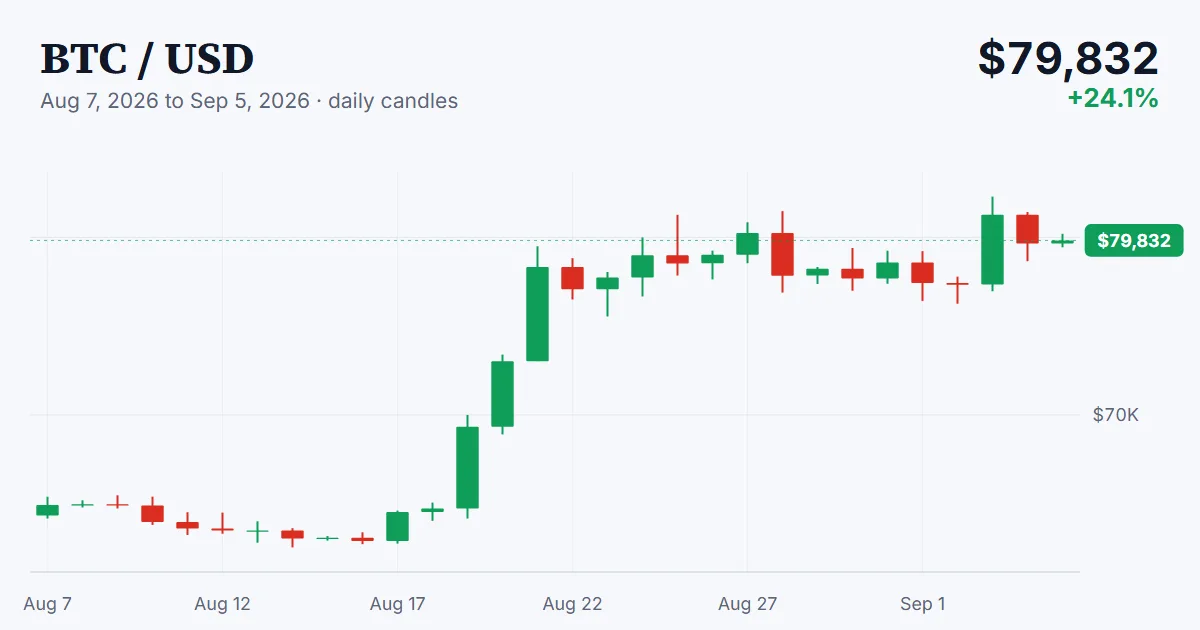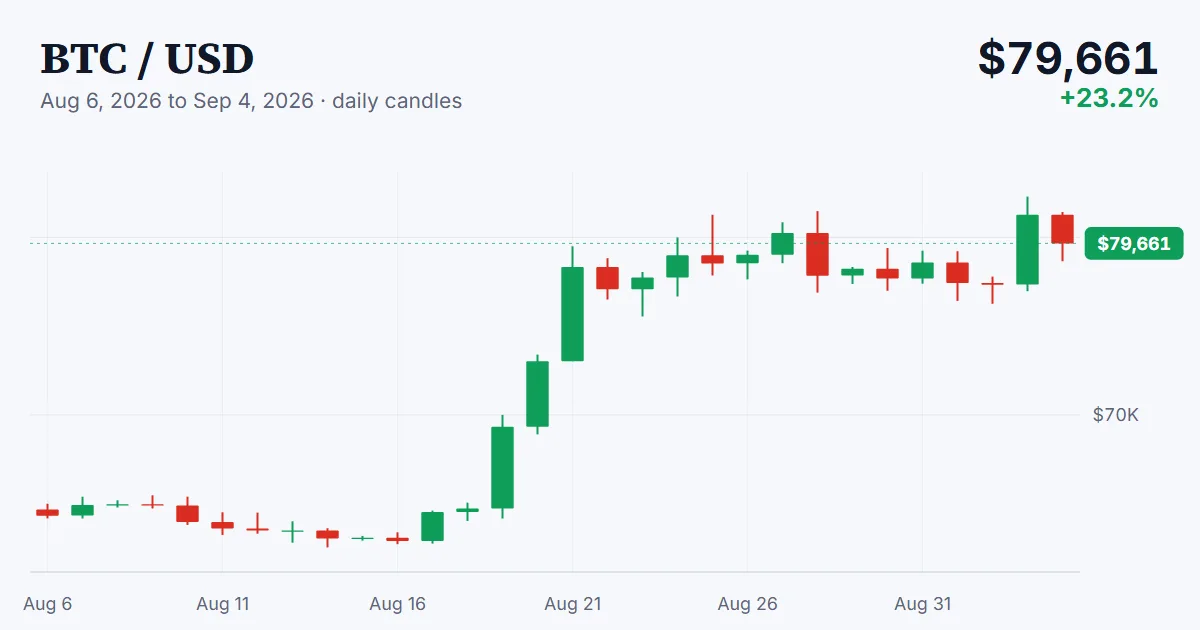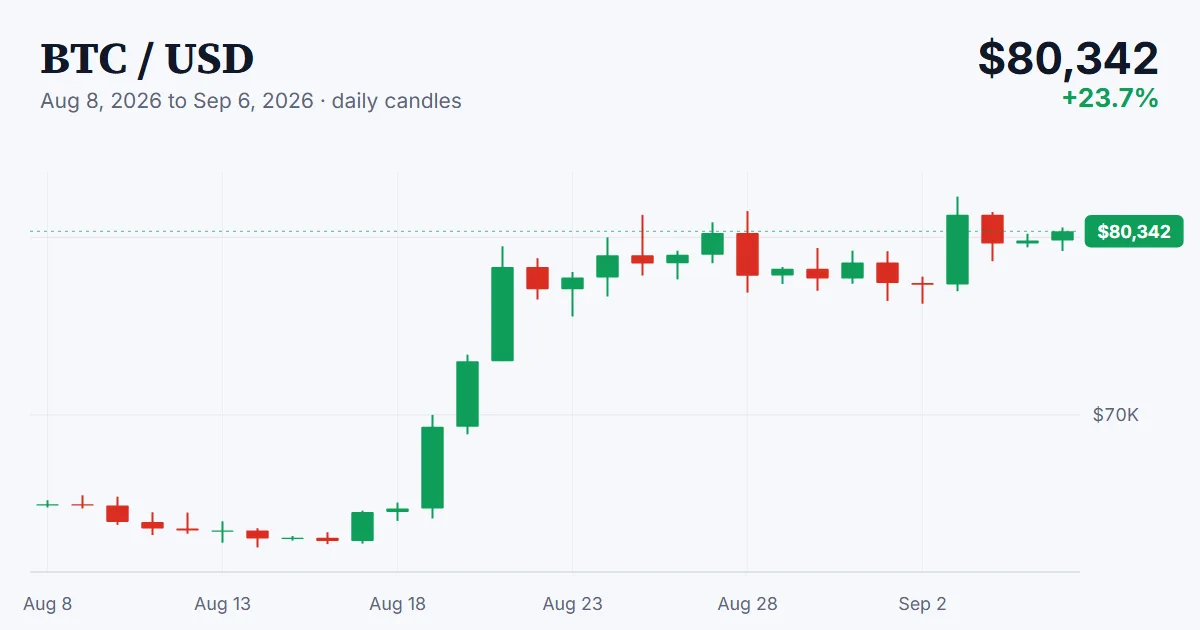
The rally that carried bitcoin to $82,000 on Thursday met a number it could not argue with on Friday. The Bureau of Labor Statistics reported that nonfarm payrolls rose by 162,000 in August, per Yahoo Finance and BigGo Finance, against a consensus of roughly 53,000 to 56,000 depending on the survey. Private payrolls added 127,000 versus an expected 43,000 to 45,000, June and July were revised up by a combined 55,000, the unemployment rate held at 4.1 percent, participation was 61.6 percent, and average hourly earnings rose 0.3 percent on the month and 3.1 percent on the year. Almost every line in the release pointed the same way: a labor market that is not weakening the way a rate cut would require. CME FedWatch pricing moved accordingly, per BigGo Finance, putting the probability of a 25 basis point hike at the September 15 to 16 meeting at 58 percent, up from 49.4 percent before the report.
Bitcoin's reaction was quick and orderly rather than violent. It opened Friday near $81,272, per Yahoo Finance's morning note, held above $81,000 until the 8:30 a.m. ET release, then sold off to a session low around $78,650 to $78,700 and stabilized. The September 4 close was $79,671 against $81,265 a day earlier, per The Coin Republic, a loss of about 2 percent, on daily volume of $39.84 billion versus $26.62 billion on Thursday. Saturday morning it traded near $79,715 with a 24 hour range of $78,706 to $79,848, per Bitcoin.com, and ether was about $2,507, down roughly 2 percent, per Yahoo Finance. The midweek high, variously logged at $82,281, $82,400 and $82,500 by our sources, now stands as the rejection level; trader Garrett Jin, quoted by Yahoo Finance, described the price as "rejected brutally" there with short positioning building up underneath. Two days ago Governor Waller's openness to a hold was the reason to buy. Friday's data is the reason he attached a condition to it.
The ETF bid shrank by three quarters and did not turn
The flow numbers are the part of Friday that matters most for how the next weeks trade, and they are more nuanced than the headline. US spot bitcoin ETFs took in $174.6 million on September 4, per Yahoo Finance and The Coin Republic, down 76 percent from Thursday's $730.9 million, the biggest day since January. BlackRock's IBIT accounted for $117.4 million of Friday's total and Fidelity's fund for $57.2 million, and IBIT's net asset value fell 2.14 percent on the day while still absorbing new money. Ether ETFs followed the same shape at a smaller scale, from $141.4 million on Thursday to $26.5 million on Friday, an 81 percent decline. What did not happen is an outflow. The four sessions from September 1 to 4 closed with net bitcoin ETF inflows of about $987 million on both SoSoValue and Farside counts, and the last three weeks combined for $3.8 billion, which The Coin Republic calls the strongest three-week period of 2026. IBIT now holds $62.52 billion of the sector's $101.3 billion, a 62 percent share, and cumulative net inflows since launch stand at $55.6 billion, even though, per the same outlet, the 2026 year to date tally remains roughly $1 billion negative after the heavy redemptions earlier in the year.
That is the honest framing of the week: allocators who spent the first half of 2026 pulling money out have spent three weeks putting it back, and Friday's macro shock slowed the pace without reversing it. The pattern also tells us something about who was buying on Thursday. A $731 million day followed by a $175 million day, with the price down 2 percent in between, is consistent with momentum-driven flows that chase a breakout and pause when it fails, rather than with a steady programmatic bid. Steady bids do not fall by three quarters on one data release. The distinction matters because the next test is a week away and the market has already told us what it is. Joseph Purtell, quoted by the Associated Press and relayed by BigGo Finance, put it plainly: September's meeting is going to be knife edge and it is going to come down to how the CPI data prints. Waller said the same thing on Thursday in his own words, per Yahoo Finance, when he pointed to next week's inflation report as the number that would decide whether he favors holding or raising.
Three times the consensus; unemployment steady at 4.1 percent.
CME FedWatch for September 15 to 16, up from 49.4 percent.
Close $79,671, down about 2 percent; volume $39.8B.
Down 76 percent from Thursday, still positive; week at $987M.
Levels, sentiment and the supply event landing today
The technical map has not changed much, which is itself the finding. Bitcoin.com's Saturday read has daily relative strength at 67, off the overbought zone after a four hour reading above 70 midweek, with support at $78,500 to $79,100, which is where Friday's low held, and deeper support at $76,000 to $77,000, which BigGo Finance's liquidation map flags as the next cluster of leveraged longs. Resistance is $80,000 first, then $81,250 to $82,281. The moving average stack still slopes up, with the 10 day near $78,500 and the 20 day near $76,000, and the longer averages that matter for a trend change sit far below: the 50 day simple moving average is $68,759 and the 200 day $69,621, per BigGo Finance, so the price is about 13 percent above its highest long average even after Friday. The Crypto Fear and Greed Index printed 73, still in greed, and futures open interest was $54.42 billion, per The Coin Republic. A 2 percent pullback against those readings is a rotation inside an uptrend until proven otherwise; a close below $78,500 on rising volume would be the first thing to prove otherwise.
Two dates frame the coming week. The first is the consumer price index release, which the Fed's own swing voter has named as his decision variable and which now carries a coin-flip hike behind it. The second is today. Hyperliquid's core contributor tranche of 9.92 million HYPE, worth roughly $800 million at late August prices, unlocks on September 6, an event we broke down last week; the March tranche saw only 1.75 percent of scheduled tokens actually claimed, per CryptoTicker, so the realized supply is likely to be a fraction of the headline, but it is the largest single unlock of the month landing into a market that just lost its momentum bid. Our reading is unchanged from Thursday, only the odds have moved. ETF money is returning to bitcoin at the fastest pace of the year, macro is deciding how much of it stays, and the price is trading exactly where those two forces balance: a few hundred dollars under $80,000, waiting for next week's inflation print. None of this is trading advice, and a jobs report is one data point in a series that has been revised in both directions all year.