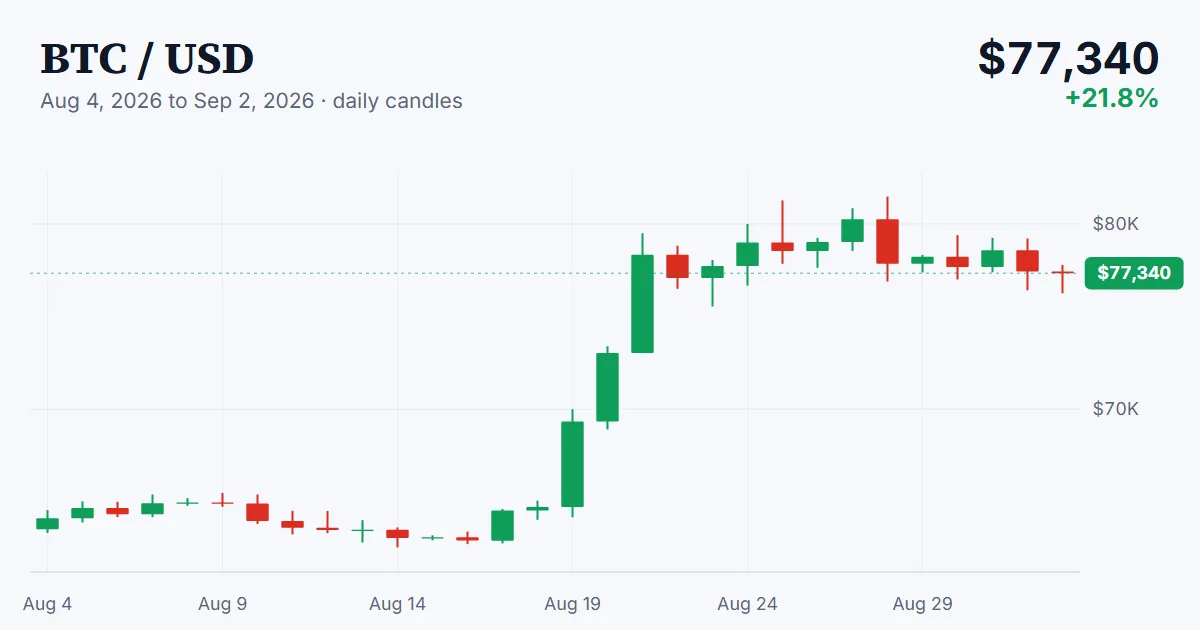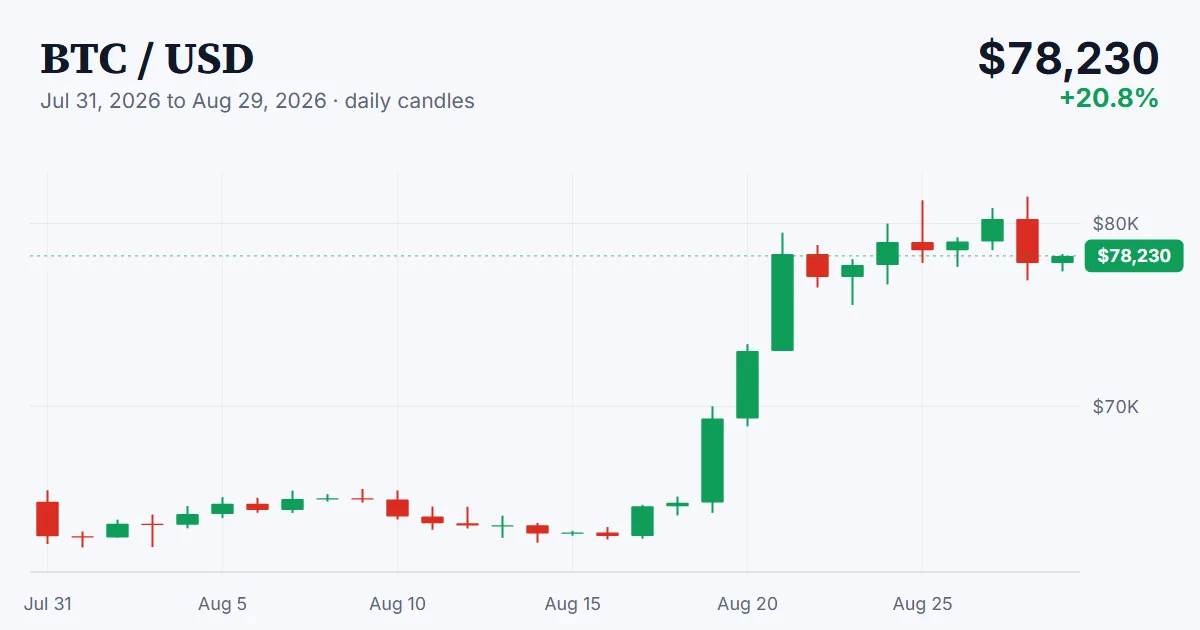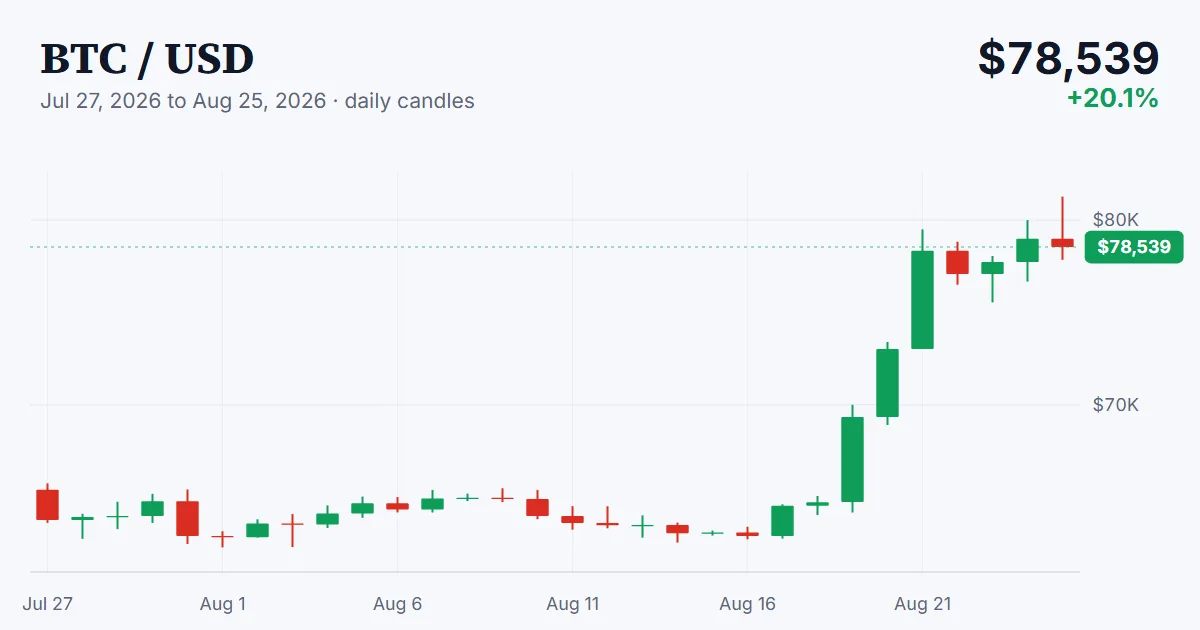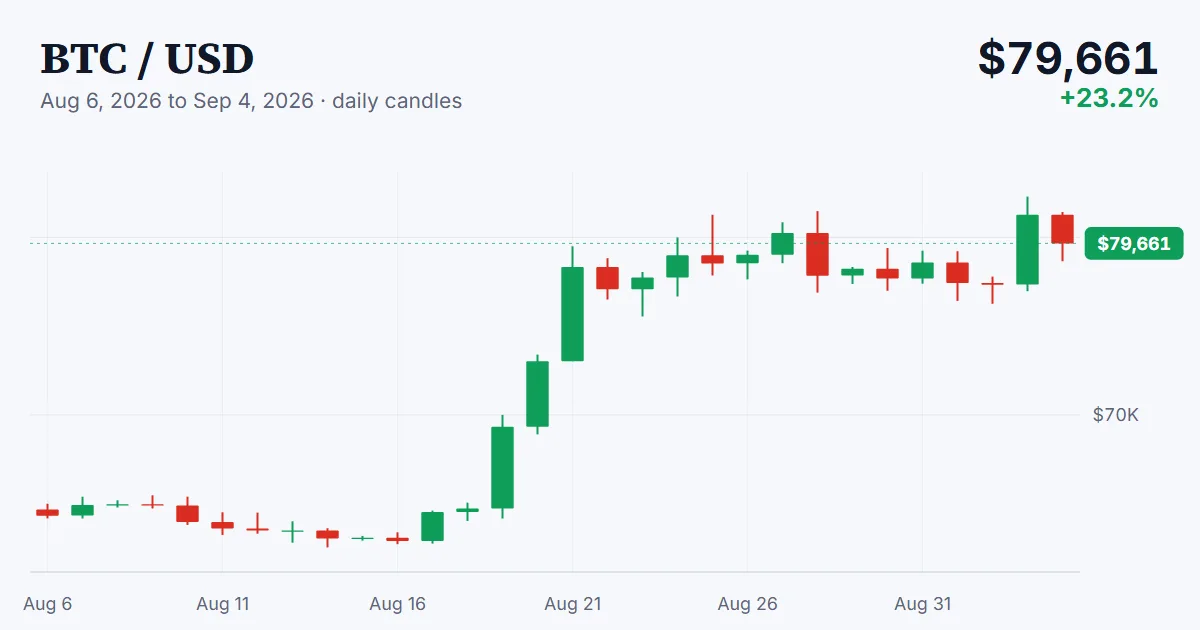
Two days ago the market was pricing a September rate hike at nearly 70 percent and bitcoin was sliding under $77,000 on oil and yields. On Thursday, one Fed governor talked half of that away. Christopher Waller, in remarks prepared for a Reuters interview in Washington, said that if the disinflation trend holds in the data due over the next two weeks he would be inclined to support keeping the federal funds rate where it is at the September 15 to 16 meeting, per Quartz and CNBC. He put a number on the trend, three-month core inflation down from 4.76 percent in February to 3.05 percent through July, and a line on it: to paraphrase John Lennon, he is willing to give disinflation a chance. Treasury yields fell to session lows, S&P futures turned up, and CME hike odds dropped from nearly 70 percent to about 50 percent, per FXStreet. Bitcoin, which had opened at $77,310.77 per Yahoo Finance, printed $81,282 in the New York morning per Bitcoin Magazine and was at $81,491.82 by early evening, up 5.5 percent, per The Motley Fool. Coinotag reported a push as high as $82,200, which would be the highest print since May.
What Waller changed, and what he did not
The honest reading of the speech is narrower than the price reaction. Waller did not say the Fed is done; he said the August data decide it. Two prints land before the meeting, Friday's jobs report and the September 11 inflation release, and he explicitly kept a hike on the table if August shows the recent progress reversing, per Quartz. What he did do was break the hawkish consensus that Kevin Warsh's Jackson Hole keynote set a week ago, and markets that had leaned all the way into a hike had to lean back. That is why the move showed up in the dollar first. The US Dollar Index fell below 99 on the remarks, per Coinotag, and every dollar-sensitive asset followed: gold-adjacent, duration-adjacent, and crypto.
The rally was broad in a way the past week's bounces were not. Ether rose 5.2 percent to $2,511.01, Solana 5.9 percent to $105.30 and XRP 8.9 percent to $1.47, per The Motley Fool, lifting the total crypto market cap 4.7 percent to $2.82 trillion. Zcash surged 16 percent to a record $979 and Ethena's ENA gained 12 percent, per FXStreet. Equities came along: the S&P 500 closed up 1.1 percent, the Nasdaq 1.4 percent and the Dow 1.2 percent, and the crypto-linked names ran harder than the coin, with Strategy up more than 13 percent, Coinbase 11 percent, HIVE 13 percent, MARA more than 10 percent and CleanSpark 9 percent, per Bitcoin Magazine. When miners and treasury companies outrun bitcoin on a Fed headline, the market is buying the macro relief, not a crypto-specific catalyst, and it will give the move back just as fast if next Thursday's inflation print disagrees with Waller.
The dollar story underneath
CoinDesk's live blog led Thursday with a detail we think matters more than one governor's mood: global institutions are running their lightest dollar hedges in a decade. Per a Bloomberg survey reported by Bloomingbit, pension funds and insurers in Japan, Canada, Taiwan, Australia, Denmark and Finland had hedged just 41 percent of their foreign-currency exposure as of June 30, the lowest reading since at least 2015 and down from 56 percent in 2020. The spread is wide: Australia at 27 percent, Canada 38, Taiwan 43, Japan 46, Denmark 49, Finland 51. Japanese investors hedged only 41 percent of new foreign bond purchases in the first half of 2026, down from 62 percent in 2024, and Danish pensions reversed roughly half of the hedging they added in mid 2025. Bloomberg's estimate of what a normalization would mean is the number to keep: a five point rise in hedge ratios equals about $230 billion of dollar-futures selling. With the Bloomberg Dollar Spot Index already down 2.1 percent since July 1, a lightly hedged base that starts hedging again is a structural seller of dollars, and structural dollar selling is the quietest tailwind bitcoin has.
The ETF complex has not yet voted on Thursday; flows publish with a one-day lag. What it said about Wednesday was mixed. US spot bitcoin ETFs took in $101.15 million on September 2, reversing Tuesday's $236.5 million outflow, with BlackRock's IBIT at $115.45 million, Morgan Stanley's MSBT at $7.3 million and Bitwise's BITB at $4.19 million against a $56.21 million exit from Grayscale's GBTC, per HedgeCo. Ether funds lost $48 million, ending the twelve-session, $1.62 billion streak we had been tracking, with ETHA down $53.4 million, FETH $26.2 million and ETHE $23.5 million, partly offset by $53 million into BlackRock's staked ether product, and XRP funds gave up $7.2 million after eleven positive sessions, per Cointelegraph. That is rotation, not exit. The calendar from here is dense: Friday's payrolls, Hyperliquid's roughly $800 million contributor unlock on Saturday, the inflation print on September 11 and the Fed on the 16th. Waller has told the market which number he is watching. It is the same one we are.