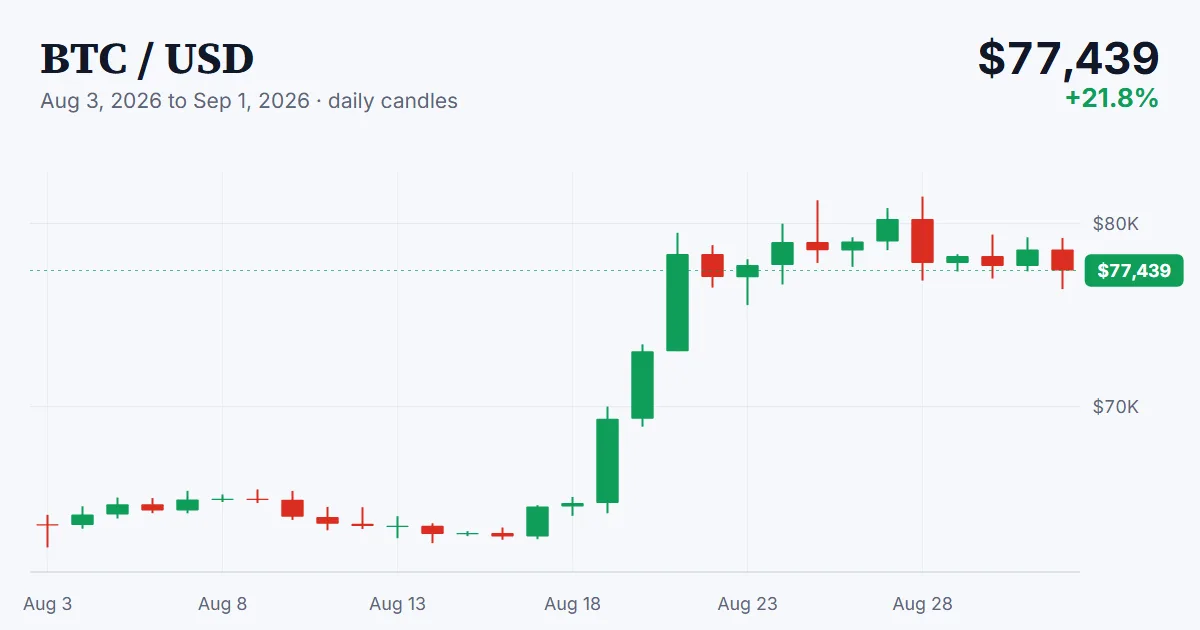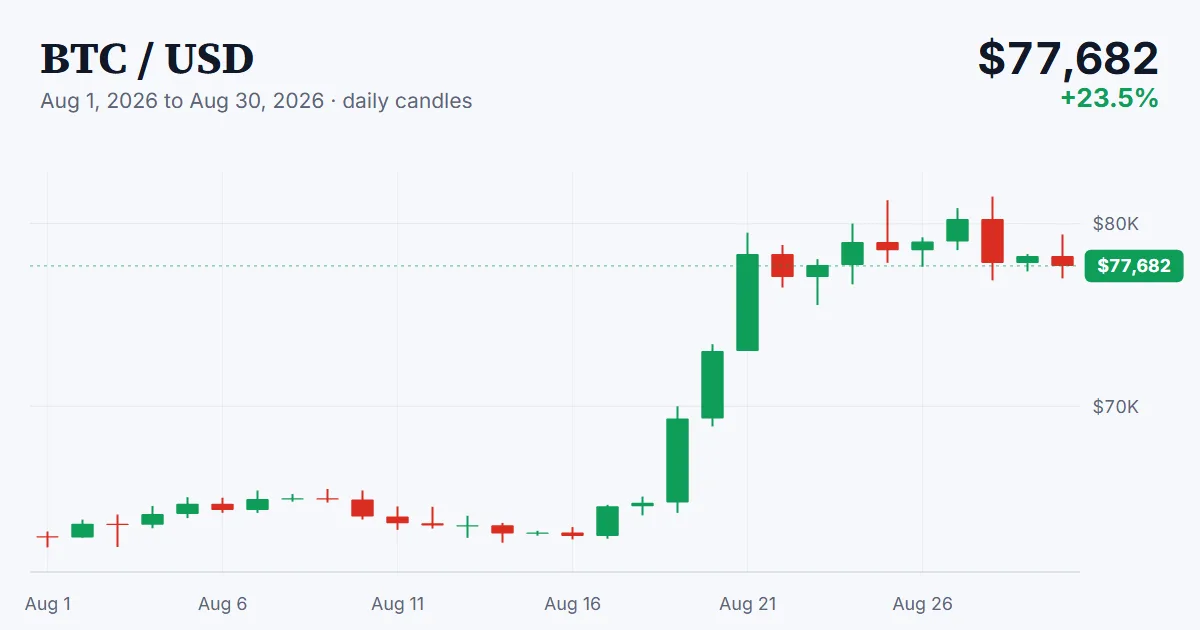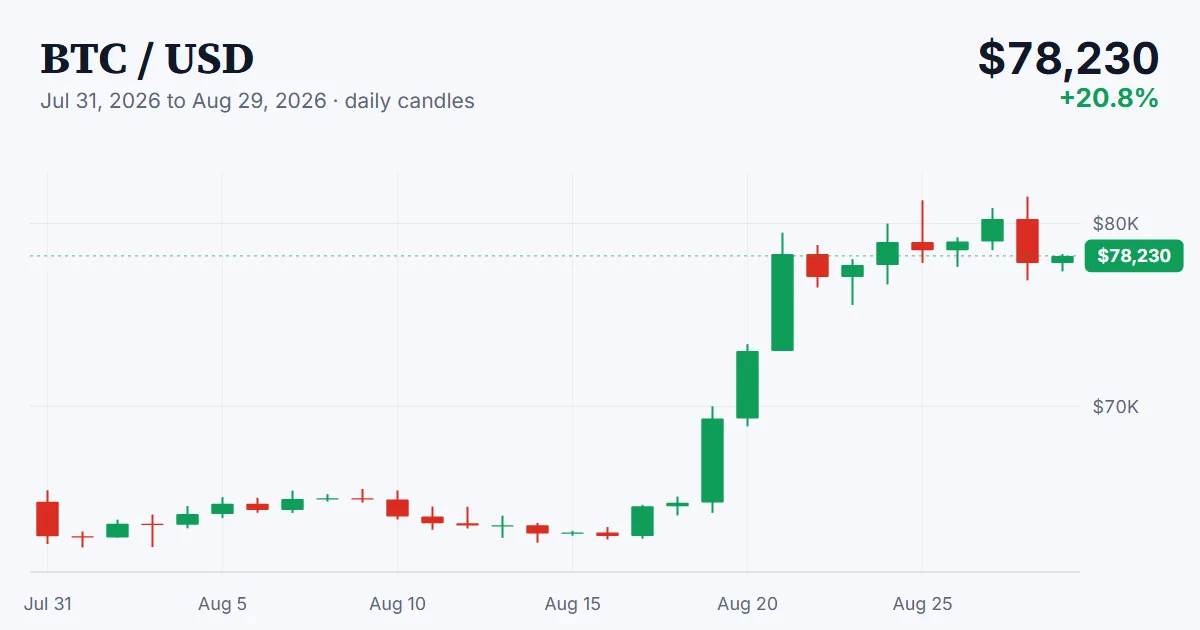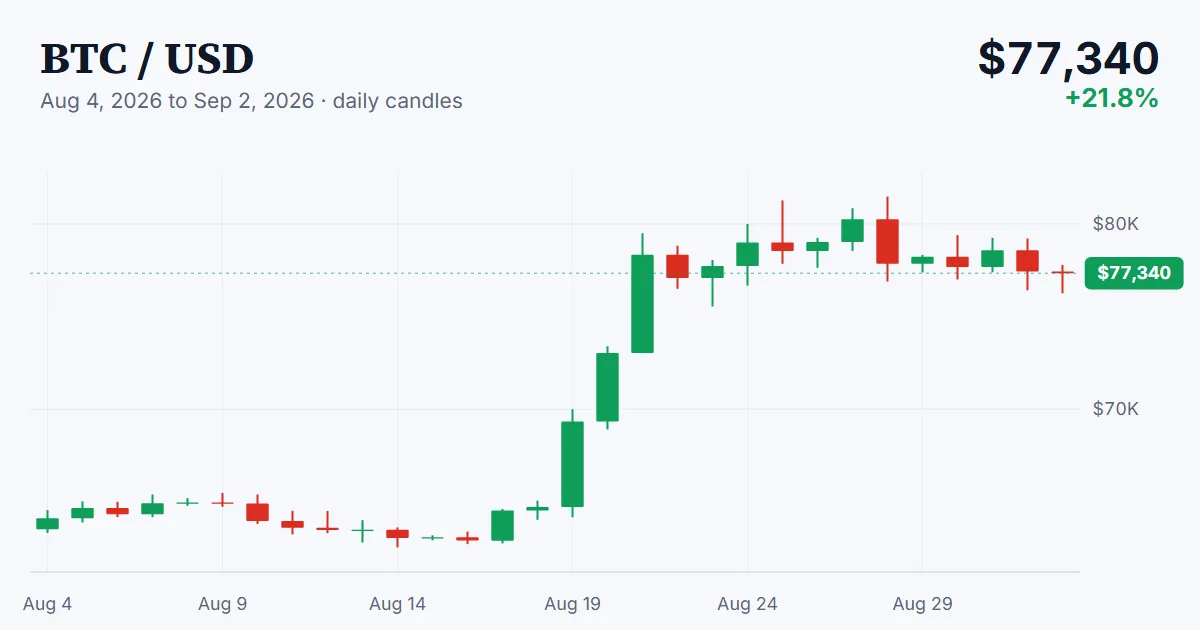
We spent the last two days writing about September seasonality and the unlock calendar, and the month's first real shock came from neither. The United States and Iran exchanged strikes again, their first direct hostilities in over a month, and the oil market did what it does when the Strait of Hormuz is in the headlines. Brent crude rose 4.6 percent to $94.65 and West Texas Intermediate climbed 5.2 percent to $90.22, per crypto.news, after Brent had already poked above $90 on Sunday. Bitcoin, which had touched $79,166 early in the session, fell through $78,000 and then $77,000 to an intraday low of $76,483, and was changing hands around $77,670 by 02:04 ET on Wednesday, down 1.4 percent, per Investing.com. The S&P 500 closed at its lowest level since August 4. It is the second time in a week that a macro headline has cut the rally off at the knees, and the second time the ETF complex has answered by buying.
The sequence, and why oil is the transmission
The military timeline matters because it explains why crypto sold off with bonds rather than with equities alone. Per CryptoRank, US forces struck two Iranian launchers on the island of Larak on Sunday, and Iran answered with strikes on military targets in Jordan. Then, from around noon ET on Tuesday, US Central Command began hitting Islamic Revolutionary Guard Corps radar and military sites, with Iranian state media reporting explosions at Qeshm Island, Bandar Abbas, Chabahar, Jask, Konarak, Minab and Sirik, per crypto.news. Investing.com adds that President Trump threatened Iran's oil export infrastructure directly. Every one of those place names sits on or near the coast through which roughly a fifth of global oil and liquefied natural gas moves, and that is the channel: a war headline becomes an oil price, an oil price becomes an inflation expectation, and an inflation expectation becomes a Fed decision.
That last link was already tight before the strikes. The 10-year Treasury yield reached 4.808 percent, its highest since January 2025, per Investing.com and Bitcoin.com News, with bond yields surging across Japan, Australia and Europe as well. CME futures priced a 66.4 percent chance of a 25 basis point rate hike at this month's meeting as of Tuesday morning, per Yahoo Finance, up from 39.6 percent a week earlier, which is the same repricing Kevin Warsh's Jackson Hole speech started and this week's energy shock extended. The damage inside crypto was broad and altcoin-heavy: ether fell 2.1 percent to $2,419, XRP 2.7 percent to $1.35, Solana 3.3 percent, Dogecoin 1.9 percent, Cardano 1.2 percent, and BNB just 0.3 percent, per Investing.com's early Wednesday read.
Leverage paid for the move, as it usually does. CoinGlass data cited by crypto.news put about $115 million of long liquidations inside a single hour as bitcoin lost $77,000. Bitcoin.com News' full-day tally for September 1 was more balanced than that headline suggests: $33.3 million of bitcoin longs and $21.7 million of shorts, with $102 million of longs and $90.6 million of shorts across the wider market. That is the signature of a choppy range where both sides got caught, not a one-directional cascade, and it fits a session in which bitcoin reclaimed $79,000 at 1 a.m. ET and lost it again within two and a half hours.
The buyers who did not flinch
Here is the part that keeps this from being a simple risk-off story. On the same September 1 session, US spot bitcoin ETFs took in $142 million net, per Farside data reported by NewsBTC, one day after the $202 million outflow that ended their nine-day streak. Ether funds did not even pause: $87.6 million of inflows made it eleven consecutive positive sessions, led by BlackRock's ETHA at $59.9 million, Grayscale's mini trust at $13.5 million, Fidelity's FETH at $9.3 million and Bitwise's ETHW at $3.7 million, per Bloomingbit. Strategy added its own weight, disclosing the purchase of 4,603 bitcoin for $369.7 million between August 24 and 30 at an average of $80,318, its first buy since June 22, taking holdings to 845,050 coins, per The Crypto Times. The largest corporate holder resumed buying at prices above where the market now trades.
We do not read that as a guarantee of anything. Flows are reported with a one-day lag, so Tuesday's strikes will show up in Wednesday's numbers, and the honest test is whether the bitcoin funds keep buying through a week in which oil, yields and the Fed all point the wrong way. What the September 1 data does establish is that the institutional bid survived the first hawkish shock and showed up again for the second. The scheduled risks have not moved: Friday's payrolls, the September 11 inflation print, and Hyperliquid's roughly $800 million contributor unlock on September 6. The unscheduled one, a shooting war around the world's most important oil chokepoint, has just reminded everyone that the calendar is not the only thing that sets the price.