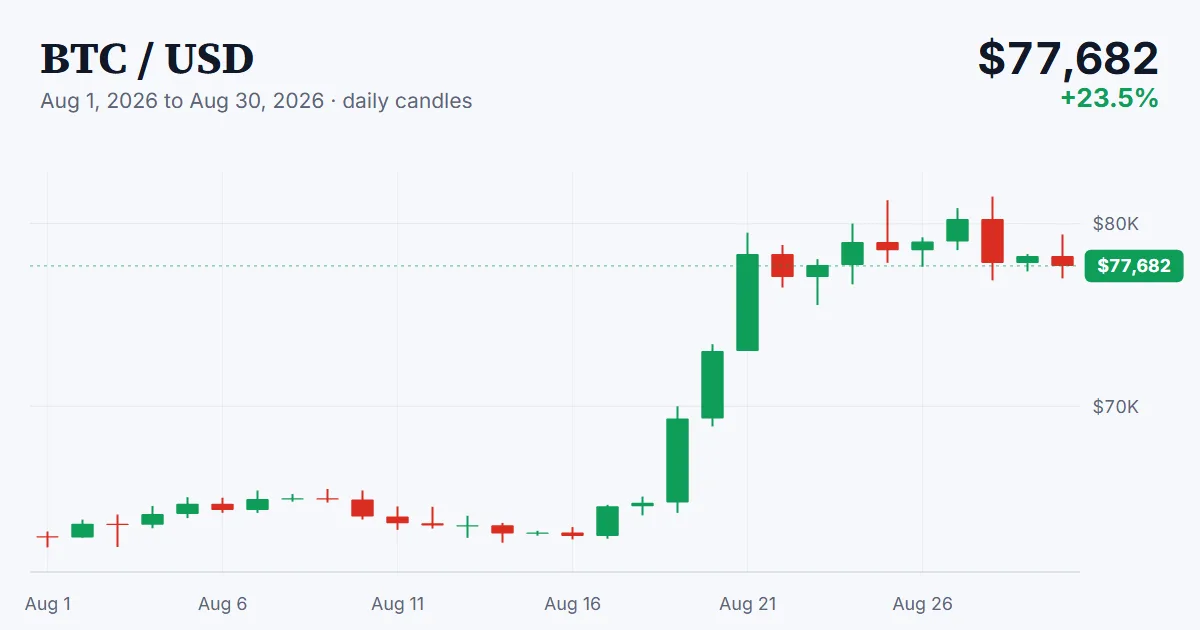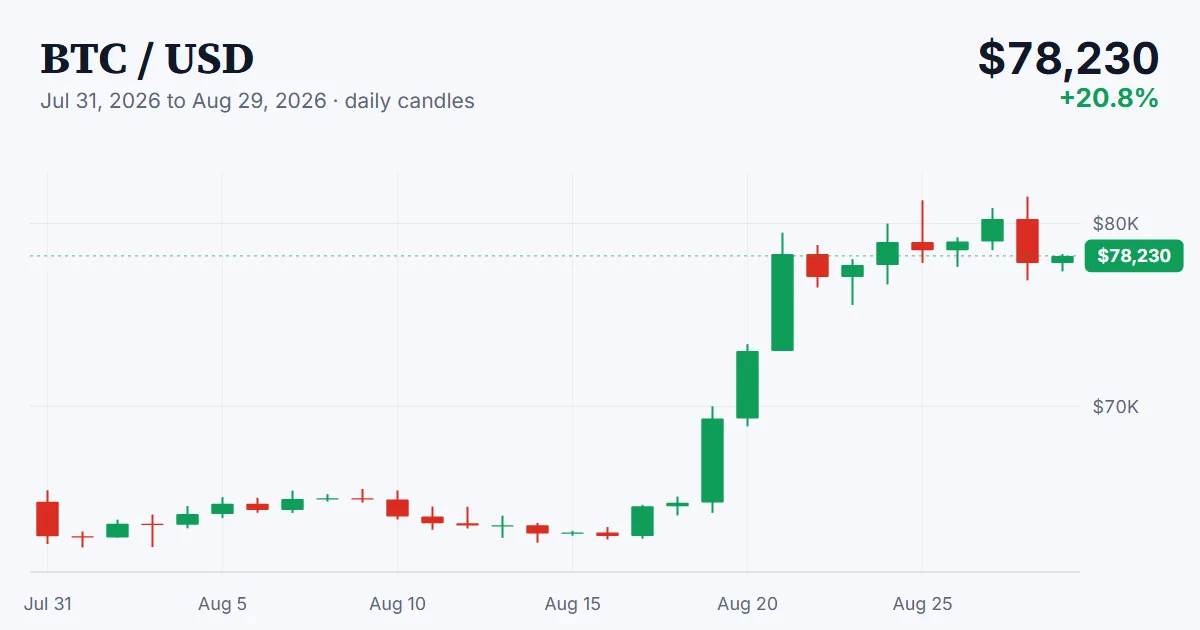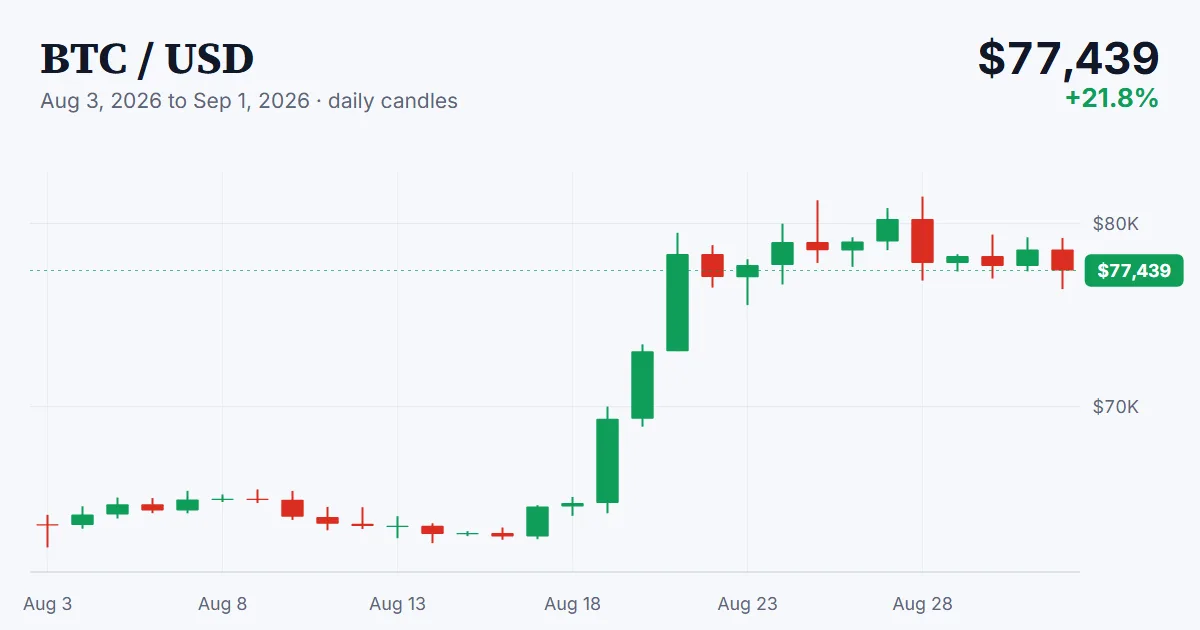
The month-end math is done and it is unambiguous: bitcoin closed August 2026 up 24.95 percent, its strongest calendar month of the year, per The Crypto Times' review of the monthly candle. The move started in the low $60,000s, topped out above $81,000 in the week after Jackson Hole, and settled near $78,000 into the close, with the price around $78,800 on CoinGecko as September opens. That makes this the first positive August since 2021 and, remarkably, the third-best August in bitcoin's recorded history, behind only the 2017 blow-off and the 2013 bull surge. Four straight Augusts from 2022 through 2025 finished red. This one broke the streak with room to spare, and the immediate question is the one the calendar always asks next: what does September do to a market that just had a month like that?
A rare kind of month
Start with how unusual the August itself was. Since 2013, only five Augusts have closed green, and the list is short enough to print in full: 2013 at plus 30.42 percent, 2017 at plus 65.32 percent, 2020 at plus 2.83 percent, 2021 at plus 13.80 percent, and now 2026 at plus 24.95 percent. The long-run August average of plus 2.82 percent sounds respectable until you see the median of minus 6.99 percent sitting underneath it, which is the statistical way of saying a few enormous outliers carry an otherwise losing month. August 2026 just joined the outliers.
The fuel behind the candle was mostly the story we covered as it happened. The ETF complex pulled in more than $3 billion on the month, its strongest month of 2026, with single days near $517 million and $606 million in the third week and a nine-session inflow streak that only snapped on the final Friday. A $3 billion short liquidation cascade on August 20 did its part, and Treasury buyback headlines plus friendlier policy signals did the rest. The month also absorbed a genuine shock without breaking: Kevin Warsh's hawkish Jackson Hole debut knocked the price off $81,455, and the tape held the high $70,000s anyway.
The September test, honestly stated
Now the uncomfortable half of the seasonality table. September has averaged a 2.86 percent loss for bitcoin since 2013, with a median of minus 2.44 percent, weak enough across enough different market regimes that the old Rektember nickname earned its keep. The recent record is friendlier: 2023, 2024 and 2025 all produced green Septembers, so the curse is not what it was. But there is a wrinkle in that improvement worth stating plainly. Each of those recent green Septembers followed a weak or negative August. The years that looked like this one, a big green August with momentum behind it, resolved the other way: 2013's strong August gave way to a September loss, 2017's monster month preceded a decline, and 2021's plus 13.80 percent August rolled straight into a minus 7.03 percent September. In the small sample we have, a strong August has never yet been followed by a green September.
We would not trade that sentence on its own, and we said as much about the unlock calendar yesterday. Seasonality is an average, not a mechanism; five green Augusts is a sample that proves nothing by itself. What it does do is set the frame for a month that already has real catalysts stacked in it: the $1.5 billion first-week unlock slate headlined by Hyperliquid's September 6 tranche, an ETF complex that just showed its first outflow in ten sessions, and a Fed chair the market is still repricing. Bitcoin enters the month above its 200-day moving average with $80,000 acting as the near cap and the high $70,000s as the floor it defended all last week. If that floor holds through the unlock week and the flows turn positive again, the seasonality table becomes a footnote. If it does not, September will have earned its reputation the usual way, with a mechanism first and the average explained afterwards.