The World Cup final had barely finished on Sunday when Hyperliquid picked its next fight. In a Telegram note, the team behind the largest decentralized perp exchange said a forthcoming enhancement to HIP-4, the upgrade that brought "outcome trading" to its mainnet in May, will support permissionless deployment of prediction markets. Once it ships, anyone will be able to launch an event market on Hyperliquid, provided they stake 500,000 HYPE and build on a template that validators have approved by vote. Deployers will earn up to 50 percent of the trading fees their market generates, and the stake is not decorative: a validator vote can slash it if a market turns out to be poorly defined or settled incorrectly. The feature lands on testnet first, mainnet later, and until then event markets remain under direct validator authority.
We track Hyperliquid for the most farmed rumor in crypto, so let us say the quiet part immediately: this announcement contains no airdrop. No snapshot, no criteria, no distribution of the emissions reserve. What it contains is something we find more interesting, a structural answer to the question of how a perp exchange enters the prediction market business without importing its settlement disputes.

Skin in the game as market design
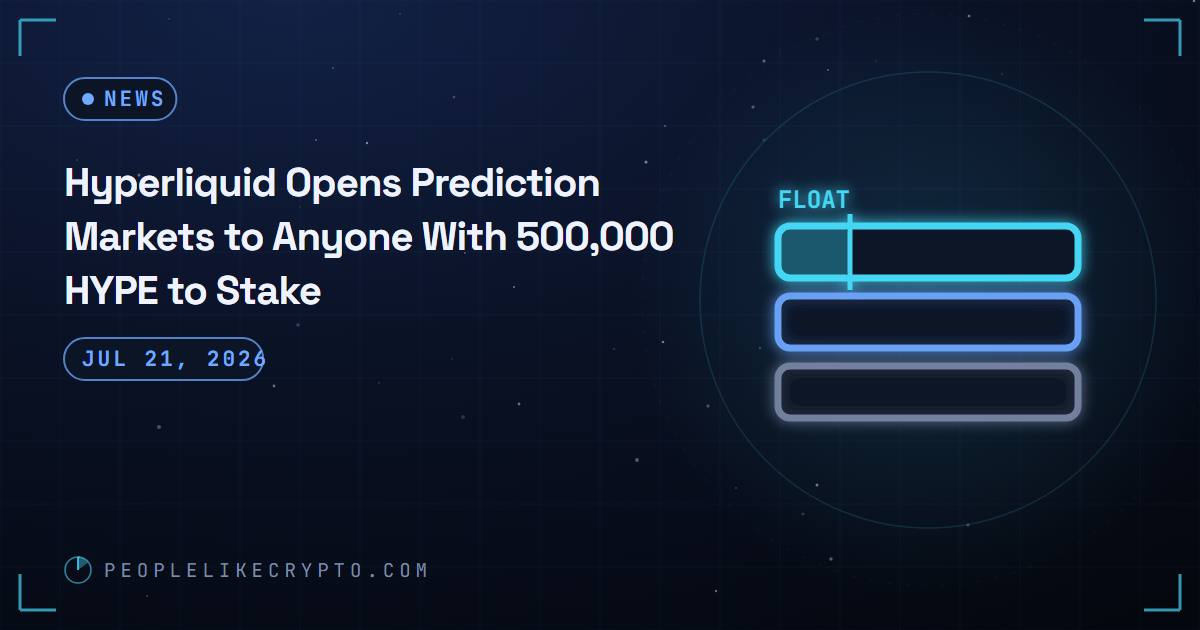
The mechanism is worth walking through, because it is the part most coverage compresses into a number. Prediction markets die on bad resolution: an ambiguous question, a lazy oracle, a settlement that contradicts what everyone watched happen. Polymarket has litigated versions of this in public for years. Hyperliquid's proposed answer is to make the market creator post a bond large enough that sloppiness is ruinous. At the $60 to $63 HYPE traded at around the announcement, 500,000 tokens is roughly $30 million of slashable collateral, an amount that prices deployment for trading firms and serious teams rather than hobbyists. The templates constrain what a question can look like, the validator vote constrains what happens when it goes wrong, and the fee share, up to half of what the market generates, is the carrot that makes the bond worth posting.
About $30M at current prices, posted by the deployer.
Question formats voted in by validators.
Deployer takes a share of market revenue.
Bad definition or bad settlement burns the bond.
Validator-run markets will not disappear, but Hyperliquid expects them to become rare once permissionless deployment is live, ideally fewer than ten per year in the team's own phrasing. That detail tells you the ambition: the validators want to be the court of appeal, not the product team.
The timing is not subtle
Prediction markets just had the biggest month of their existence. The World Cup that ended Sunday with Spain's third title drew more than $50 billion in bets across platforms by CoinDesk's count, and we covered Polymarket's record $4.25 billion winner market as it happened. The morning after the trophy, The Block reported open interest on Kalshi and Polymarket down about 20 percent as tournament positions settled. That is the exact moment a competitor wants to announce infrastructure: the sector has proven demand at a scale nobody disputes, and the incumbents are watching their event of the cycle roll off the books. Coinbase and Robinhood are pushing into the same space from the centralized side. Hyperliquid arriving with a decentralized, bonded, fee-sharing version is the field getting crowded from every direction at once, and it lands while Polymarket's confirmed but dateless POLY token still has no published criteria.
For HYPE holders, the mechanical read is a new demand sink: every permissionless market locks half a million tokens for as long as it runs. HYPE moved about 1 percent on the news, from an intraday low near $59.88 to just over $60.50, then extended to around $63 on Tuesday, though it remains the one major still down on the week. For farmers, the honest read is unchanged from our tracker entry: outcome trading adds one more surface that genuine users touch and any hypothetical future scoring could observe, and it changes nothing about the fact that no second distribution is announced. Use the platform if you would use it anyway. The team just showed, again, that it builds sinks for HYPE before it builds faucets.