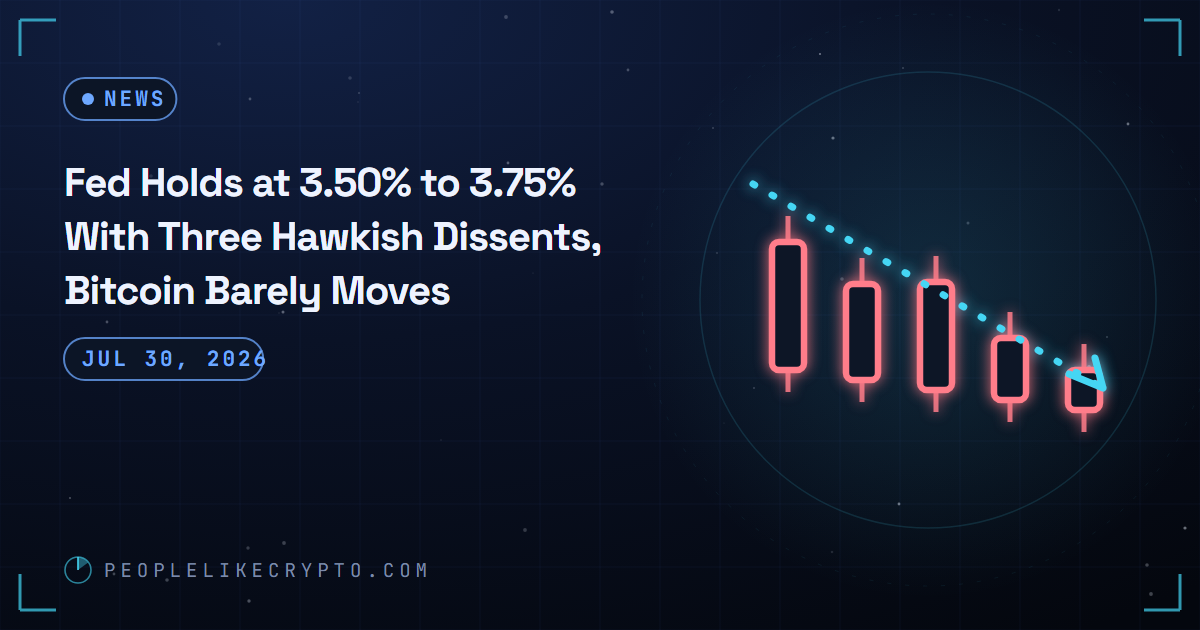
The Federal Reserve did the expected thing on Wednesday and still managed to make it interesting. The Federal Open Market Committee left its benchmark rate range unchanged at 3.50 to 3.75 percent on July 29, per CoinDesk, extending the pause to a sixth consecutive meeting. Bitcoin, which had spent the day parked just above $64,000 waiting for the answer, climbed to roughly $64,400 on the release per TheStreet, then gave most of it back overnight. By Thursday morning the price sat near $63,900, per Coin Gabbar's market data, which rounds to: the Fed met, and bitcoin moved less than one percent.
The interesting part is inside the vote. The decision passed 9 to 3, and all three dissenters, Beth Hammack, Neel Kashkari and Lorie Logan, wanted a rate increase, not a cut. That is the hawkish direction, driven by inflation that refuses to finish the job of coming down. Markets had assigned roughly a 35 percent probability to a hike going into the meeting, per CoinDesk's daybook, an unusually wide split so close to a decision. The committee chose to wait, but a third of the dissent bench pulling toward tighter policy is not the setup rate-cut hopefuls had penciled in for the second half of the year.

A pause that leans the wrong way for risk assets
For crypto, the mechanics of a hold are simple: nothing changed, so nothing should reprice. What moves markets is the path, and the path just got murkier. Chairman Kevin Warsh's press conference was the event traders actually waited for, hunting clues about whether the committee's center of gravity is drifting toward the dissenters. A Fed that spends the autumn debating hikes rather than cuts keeps the cost of holding non-yielding assets exactly where it is, and bitcoin has spent most of July trading like an asset that wants cheaper money and is not getting it. The pattern matches what we flagged in our July pivot piece: inflation prints and Fed language have been setting the tape's direction all month, with crypto-native news reduced to noise around it.
The dissent structure matters more than it usually would because this committee is new terrain. Warsh took the chair this year, the market is still calibrating how he communicates, and a 9 to 3 split gives him a genuinely divided room to represent. Sticky inflation cuts off the easy dovish exit; hiking into an economy that most members judged not to need it is a harder sell. The next scheduled decision lands in September, and until then every inflation print inherits the weight this meeting declined to resolve.
The tape reads cautious, not broken
The broader market backdrop explains why one meeting could not fix sentiment. Total crypto market capitalization sits near $2.27 trillion, per Coin Gabbar, essentially flat over 24 hours, with ether around $1,915 and bitcoin dominance at 56 percent. The fear and greed index reads 28, firmly in fear, and DeFi tokens fell 11.5 percent as a group, the kind of divergence that says traders are trimming the risk curve's far end first. Ether in particular has round-tripped the enthusiasm from the cooler CPI print earlier this month, and bitcoin remains well below the levels it held before Strategy's record sale rattled the treasury-company narrative.
Up 0.18% in 24h, dominance at 56 percent.
Up 0.24%, still far off its July highs.
Fear and greed index stuck in the fear band.
The far end of the risk curve sold hardest.
None of this resolves before the data does. A hold with hawkish dissents is the committee saying it does not know yet, and a market at fear-level 28 is traders saying they noticed. The clean takeaway for anyone holding through it: the September meeting is now the live event, the inflation prints between here and there are its previews, and a sub-one-percent reaction to a Fed decision is what a market looks like when it has already braced.