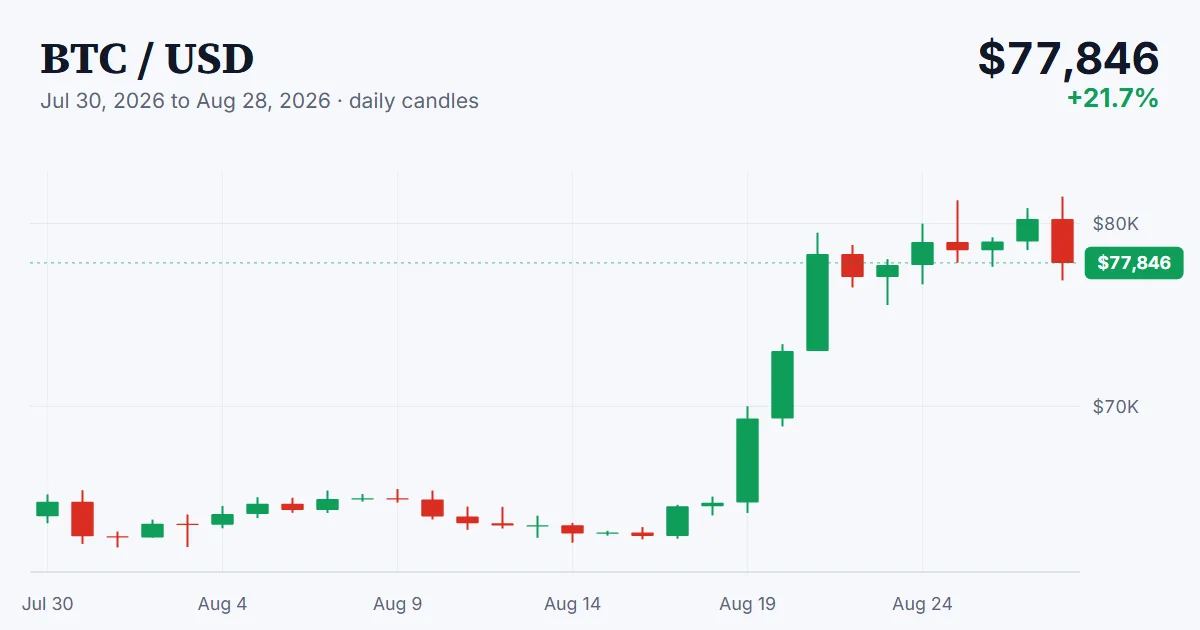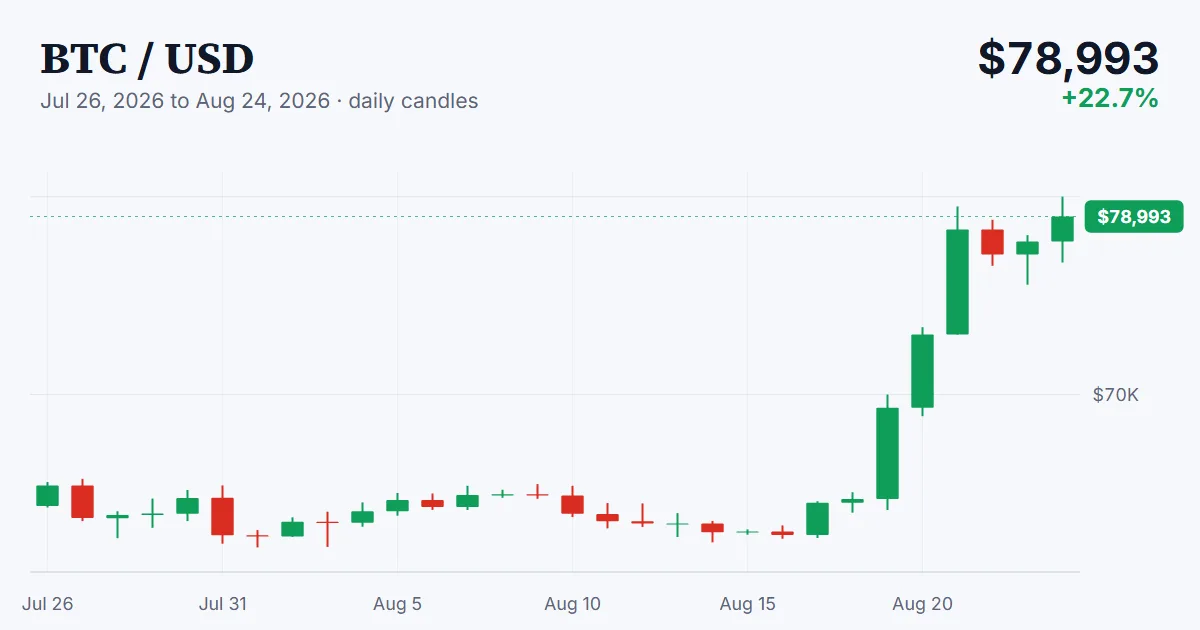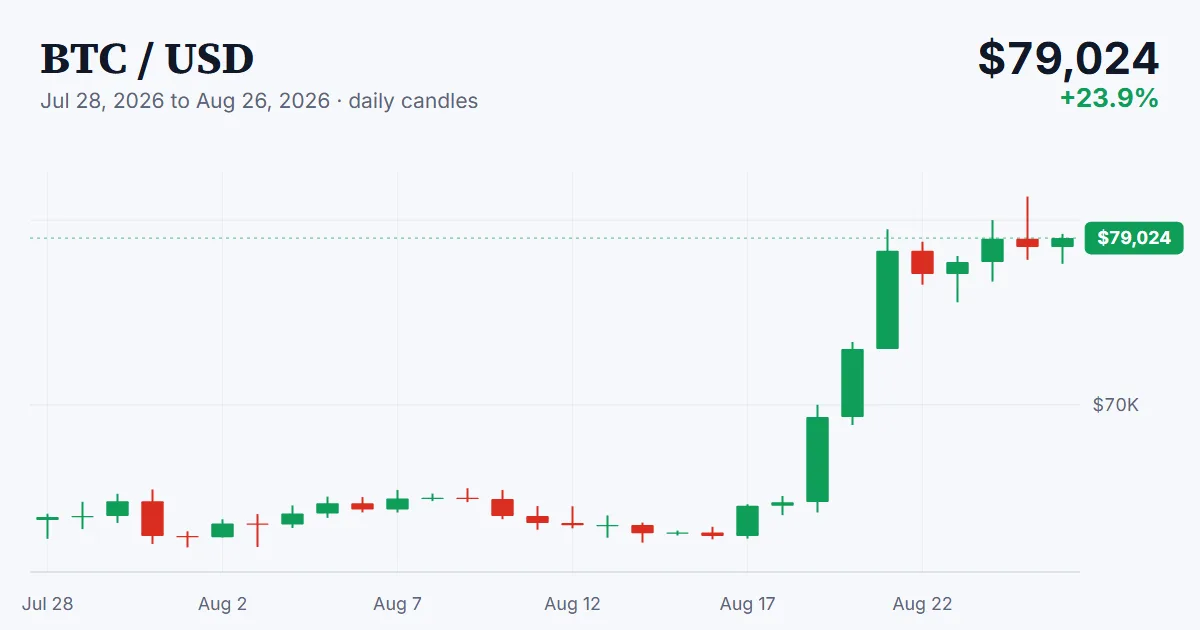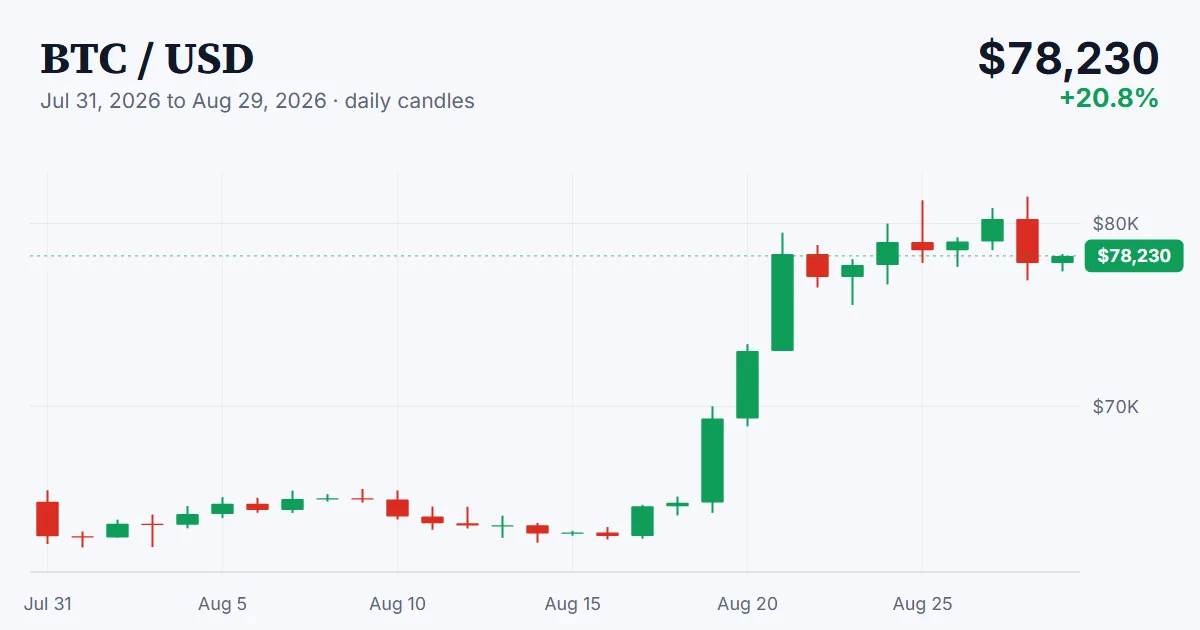
The event this whole month had been building toward finally arrived, and it bit. Kevin Warsh delivered his first Jackson Hole keynote as Fed chair on Friday morning and chose the hawkish fork: inflation is still too high, the Fed is not confident it is falling fast enough, and, in his words, "we have work to do" if underlying price pressures fail to ease, per Crypto Briefing. Bitcoin, which had squeezed to $81,455 overnight, its highest print since May 15 per CoinDesk, gave back roughly $4,000 within hours. About $488 million in leveraged crypto positions were liquidated on the day per CryptoSlate, more than $360 million of them longs, and as of Saturday morning bitcoin trades near $77,500, down about 2.8 percent over 24 hours per CoinGecko. The nine-day ETF inflow streak we covered on Thursday now meets its first real test.
A squeeze to $81,455, then the podium
The sequencing matters, because the market walked into the speech at maximum altitude. Thursday's New York session opened with a dip to about $78,920 that buyers absorbed, per CoinDesk's live coverage, and the absorption turned into a short squeeze overnight that carried bitcoin to $81,455, a level last seen in mid-May. That print landed hours before Warsh stepped to the podium at 10:00 Eastern on Friday, and hours after $6.4 billion in bitcoin options expired, per CoinDesk. When the hawkish message hit, the unwind was violent in exactly the way crowded trades are: CryptoPotato clocked a $3,000 drop in about 60 minutes with $200 million in longs liquidated within a single hour.
The damage spread in the usual order of beta. Ether fell about 2.7 percent to trade near $2,420 and XRP dropped almost 5 percent to $1.36, per Coinpedia, while the total crypto market cap shed about 3 percent. None of that is unusual for a Fed surprise. What is unusual is the direction of the surprise: this was the first Jackson Hole in years where markets left pricing a meaningfully higher chance of a rate hike rather than a cut.
What Warsh said, and what repriced
The substance was tighter than the headlines. Warsh called the economy "strong and resilient" with unemployment at 4.1 percent, then pivoted to the part markets cared about: PCE inflation is running 3.7 percent year over year and 4.1 percent annualized over six months, both well above target, per Crypto Briefing. His key sentence, "we must be confident that underlying inflation is moving to our objective, clearly and at sufficient speed, otherwise we have work to do," reads mild on paper and repriced everything in practice. Futures markets moved September rate-hike odds from roughly 35 percent before the speech to between 50 and 60 percent after it, per Crypto Briefing, and Treasury yields climbed alongside.
There was one line crypto natives will keep. Warsh acknowledged bitcoin as an important asset and a signal that can check monetary policy, per Crypto Briefing, even while repeating that volatility limits its use as a currency. A Fed chair describing bitcoin as a check on his own institution, at a symposium themed around financial innovation, is a milestone that got buried under the red candles it caused. He also said the Fed's habit of steering markets with forward guidance has "overstayed its welcome," per Coinpedia, which in plain terms means fewer promises and more data dependence, and therefore more days like Friday.
Our read: this is a repricing, not a regime change, at least so far. The structural story that carried bitcoin from $64,000 to $81,000 this month, Treasury buybacks, nine straight days of ETF inflows worth over $3 billion, a leverage flush already behind us, did not disappear because one speech leaned hawkish. But the market's clean positioning is gone: Friday rebuilt the case for caution, and the two-week rally we traced through the rejection at $81,265 and the eight-day inflow streak now has a defined ceiling with a Fed chair standing on it. The tell for next week is simple, and it is the same one we flagged Thursday: whether the first ETF outflow day arrives, and whether it comes with size. Institutional money kept buying through a hot PCE print, as it did when Warsh week began. Whether it buys through a Fed chair openly discussing hikes is the question that decides if $77,000 is a dip or a top.