The XRP Ledger disclosed on October 9 an integer overflow in its payment engine that could have created spendable XRP beyond the 100 billion cap in a single transaction. Cayden Liao and the Veria AI agent reported it on September 22. The emergency release xrpld 3.4.1 fixed it on September 25. XRPL says it found no evidence the bug was ever used.
Backfill entry The report, the patch and the disclosure are older than 72 hours. The fresh part is the October 11 reporting: The Block put the bounty at $250,000 and quoted the researcher and a RippleX engineer on why the fix shipped the way it did. We cover the mechanism because it is the useful part.
How one payment could have printed XRP
The XRP Ledger has a built-in order book. A payment can consume many offers at once, and the engine adds up the XRP owed to each offer owner. That addition used plain 64-bit integers with no overflow check. Push the sum past the ceiling and it wraps around to a small number, the way a car odometer rolls past its last digit.
The engine then paid every offer owner in full and charged the buyer only the wrapped total. New XRP that had never existed filled the gap. A safety invariant, the rule that no XRP may be created, did not catch it, because that check used the same arithmetic. According to the report, an attacker needed hundreds of deliberately priced offers, then one payment, and paid nothing beyond account reserves and transaction fees.
The sizes explain the headlines. A 64-bit integer tops out near 18.4 quintillion. XRP is counted in drops, with a million drops to one XRP, so the wrap point is about 18.4 trillion XRP. That is roughly 184 times the supply cap, which is the figure The Block and CCN used. Gizmodo wrote billions. The official report commits to no number and says only that the XRP would have sat in ordinary accounts, ready to move, trade or send to exchanges.
Payment engine sums offers with unchecked 64-bit math.
Cayden Liao and Veria AI file it through the bug bounty.
Emergency release. Over 80% of default UNL validators upgrade that day.
Report published. fixBatchV1_2 amendment goes active.
The Block reports the maximum payout went to Veria Labs.
Why the fix skipped the amendment vote
XRPL normally changes transaction processing through amendments, which validators vote on over weeks. The overflow fix went straight into 3.4.1 and took effect on each server the moment it upgraded. The report calls this the first deliberate change of that kind since the amendment system was introduced more than ten years ago.
Time drove the decision. The exploit was cheap, and the patch would be visible in the open-source code the moment it was published. Under the normal process the bug would have stayed usable for weeks while votes were counted. Validators chose the risk of a brief upgrade window instead, and more than 80 percent of the default UNL, the validator list most servers trust, ran 3.4.1 before the source code was published. "This case does not change how the XRP Ledger makes protocol changes," the report says.
The second bug in the same report took the ordinary route. A Batch transaction, which lets one account submit several transactions as a unit, accepted inner transactions wrapped in the wrong field. No funds were lost. The fix is the fixBatchV1_2 amendment, which became active on October 9, the day of the disclosure.
Node operators are the only people with a task. Servers older than 3.4.1 are amendment-blocked and fall out of sync. Holders and exchanges need do nothing.
What the bounty says about AI bug hunting
The Block reported on October 11 that the XRPL bug bounty paid its $250,000 maximum. Liao, a co-founder of Veria Labs, said the finder was an AI agent working on its own. "To our knowledge, that's the largest ever paid out for a vulnerability discovered entirely by an AI agent," he told The Block. RippleX engineer Mayukha Vadari said in the same story that AI has changed the calculus for patching, because a critical fix slipped into a routine release would now be spotted at once.
That cuts both ways. The same tools that found a 2015 bug in 2026 can read a public patch and work backwards to the exploit, which is the argument XRPL made for shipping first and voting later. The report lists audits, public attackathons, AI-assisted red teaming, fuzzing and formal verification as its layers. One of them worked here. The invariant that should have been the last line did not, because it shared the flaw it was meant to catch.
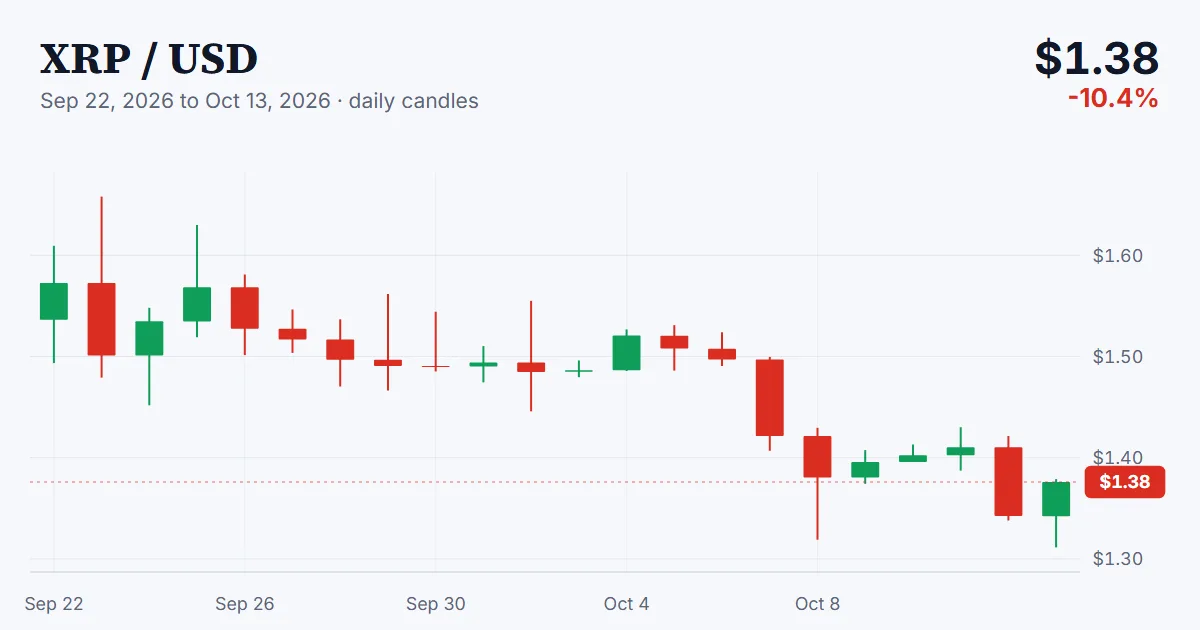
XRP traded through the whole episode without a public signal. The chart below shows Binance daily candles from the report date to today, with the patch and disclosure marked. The cached closes were $1.57 on September 25 and $1.40 on October 9. We do not attribute either level to the bug; the market knew nothing until October 9, and the patch was already a fortnight old by then.
Two things to watch. XRPL's disclosure cadence is now visible: the Batch bug was reported September 18, the overflow September 22, and both were published October 9, after the fixes were live. A sponsored-fees bug reported August 7 was disclosed September 21 on the same pattern. And Veria Labs has not said which other networks its agent is testing. The next report of this kind may not come from XRPL.