Anza said on October 13 that Alpenglow, Solana's new consensus protocol, goes live on mainnet-beta on Wednesday, October 21 at about 14:50 UTC. It replaces TowerBFT, the voting system Solana has run since genesis, and cuts finality from about 12.8 seconds to roughly 150 milliseconds. The switch happens inside one slot on a running network, with no restart.
Finality is the point at which a transaction can no longer be reversed. Under TowerBFT a block becomes final only after later blocks have carried enough votes for it, which is where the 12.8 seconds come from. Alpenglow moves that line to the first or second round of voting on the block itself.
What changes in the vote
Solana validators today vote by sending transactions. Those votes go into blocks like any transfer, and SolanaCompass counts about 3,060 of them a second, 63 percent of everything the chain processes. Under Votor, the first Alpenglow component, votes travel from validator to validator and aggregate into certificates. They leave the blocks entirely.
Two paths run at once. If 80 percent of stake votes to notarize a block in the first round, the block is final at once. If only 60 percent does, a second round at 60 percent finishes the job. Solana's upgrade page says the design tolerates 20 percent of adversarial stake plus 20 percent of offline stake at the same time. The 150 milliseconds is an expectation, not a constant, because the fast path depends on how quickly 80 percent of stake answers.
One consequence lands on every app that reads the chain. The confirmed and finalized commitment levels become the same thing. A slot can also carry more than one candidate block during the hand-off, so streaming interfaces gain a bank_id field, and Anza has deprecated four legacy Geyser callbacks in Agave 4.3. Rotor, the second component that would replace block propagation, is not yet scheduled.
Anza recommends v4.3.0 for all mainnet validators.
First Alpenglow activation on a public cluster.
Second activation, epoch 1167.
Anza names October 21, about 14:50 UTC.
Epoch 1064, hand-off 5,000 slots later.
How the hand-off works, minute by minute
The two published times differ, and both are right. Anza's 14:50 UTC is the boundary of epoch 1064, where the SIMD-0384 feature gate activates. The chain then counts down 5,000 slots, about 17 to 18 minutes at current slot times, before the consensus switch. Solana's upgrade page gives the epoch start as about 15:00 UTC and the takeover slot as 459,653,000, so the switch itself should land a little after 15:00 UTC.
At that slot the network needs a genesis certificate signed by 82 percent of stake. Anza describes the next step as a rollback to the genesis block of the new protocol, after which Votor takes over, a hand-off it puts at hundreds of milliseconds. If the certificate does not form, validators keep running TowerBFT on vote-only blocks and resend their votes until it does.
Anza says it has completed nine migrations at scale on test clusters, simulated the switch across 1,500 nodes, and worked with 115 security researchers under a bug bounty above 25,000 SOL.
Validators have two requirements. They must run a client built on Agave 4.3.0, which means Agave, Jito-Solana or Harmonic Salsa, and they must hold at least 0.8 SOL in their vote account above the rent-exempt minimum. That balance pays the validator admission ticket, a fee of 0.8 SOL per epoch that is burned and that has applied since July 22. A validator that cannot pay neither votes nor produces blocks in the next epoch.
The clients that cannot take part are the open question. Firedancer, Frankendancer and FireBAM are not supported during the migration, and Crypto Briefing reported on September 11 that Jump's Firedancer team ends Frankendancer support when Alpenglow activates. SolanaCompass counted about 15.8 percent of activated stake on those clients on October 13. That stake either moves to an Agave-based client before epoch 1064 or stops voting.
What to watch before epoch 1064
The decision itself is old. Validators approved the protocol as SIMD-0326 in September 2025 with 98.27 percent of participating stake in favour and 52 percent of network stake taking part, The Crypto Times reports. What is new is the date and the fact that two public clusters have already made the switch, testnet on September 24 and devnet on September 25.
SOL holders and app users have nothing to do. Wallets keep working, programs keep running and the execution layer is unchanged. Exchanges, RPC providers and indexers carry the work: new streaming callbacks, the bank_id field, and a clock sysvar whose timestamp will come from the leader rather than from a stake-weighted median of votes. Anza bounds that value at the parent's timestamp plus twice the slot duration.
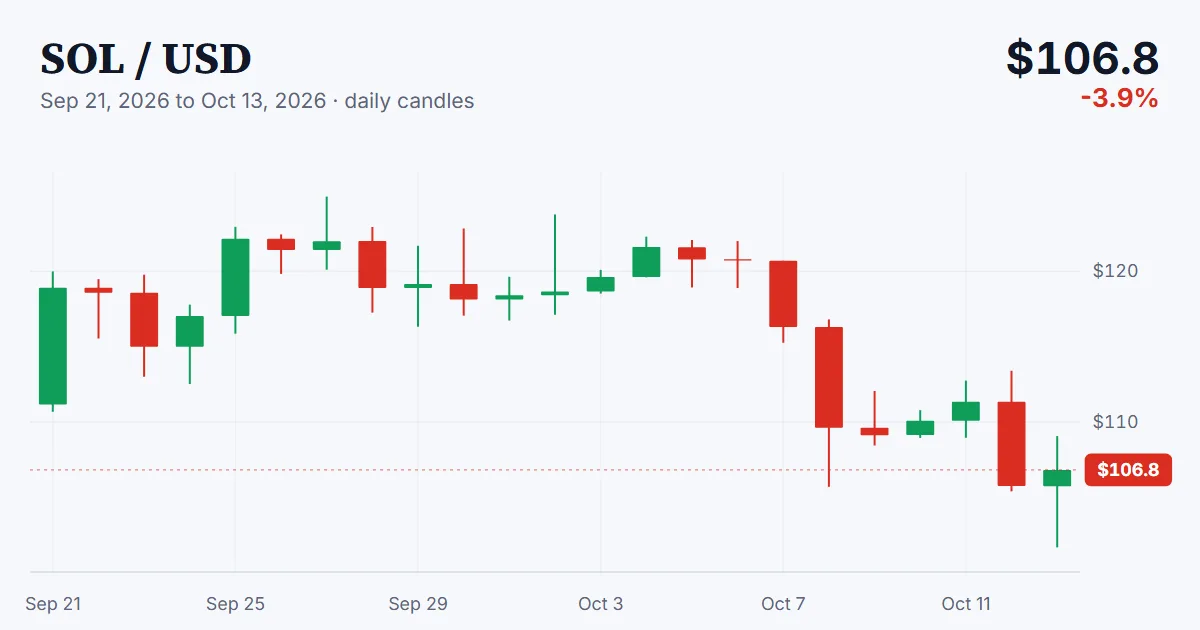
The chart below shows SOL on Binance from the Agave 4.3 upgrade call to the date announcement. The cached closes were $117.04 on September 24, the testnet day, and $106.83 on October 13. We draw no link between those prints and the upgrade.
Three things will tell the story on October 21. The share of stake on Agave 4.3 clients at the epoch boundary, which decides how quickly the 82 percent certificate forms. The time between the boundary and the first Alpenglow block, which Anza expects to be about 18 minutes of countdown plus a hand-off measured in milliseconds. And Anza's own account, which it has asked followers to track during the countdown. A Rotor date would be the next milestone after that, and none has been given.