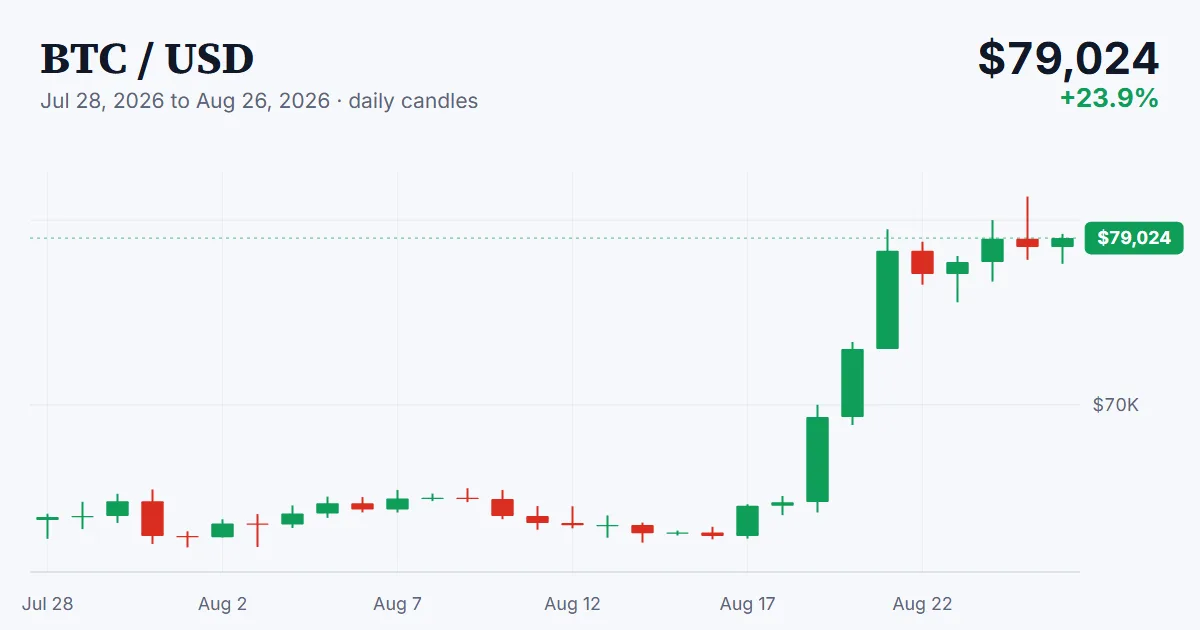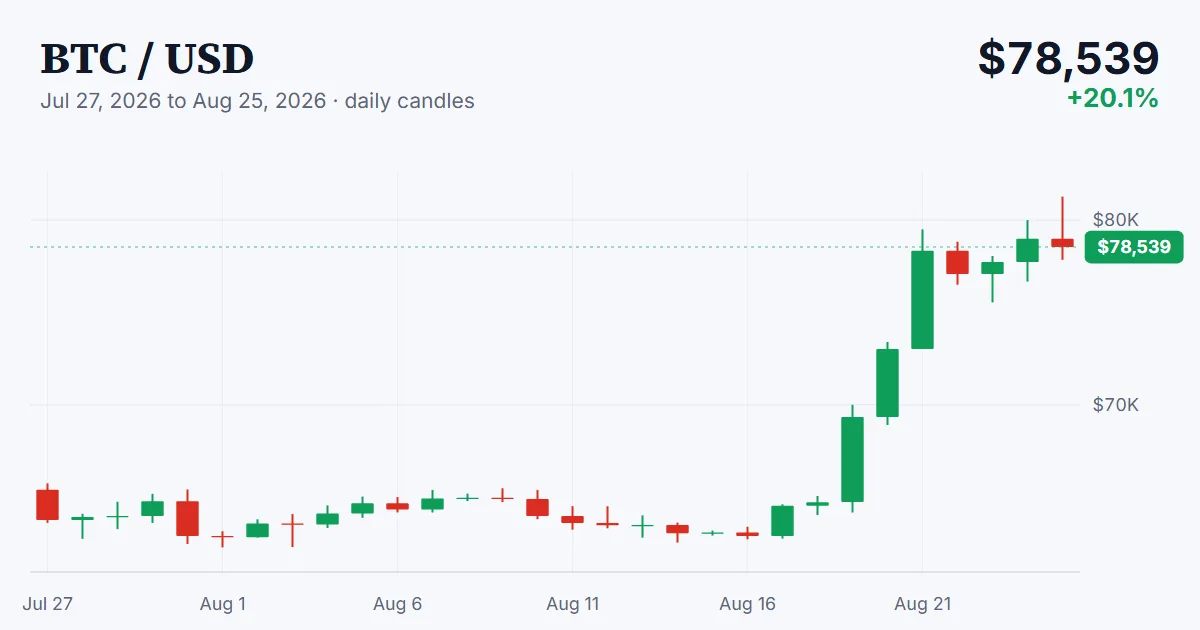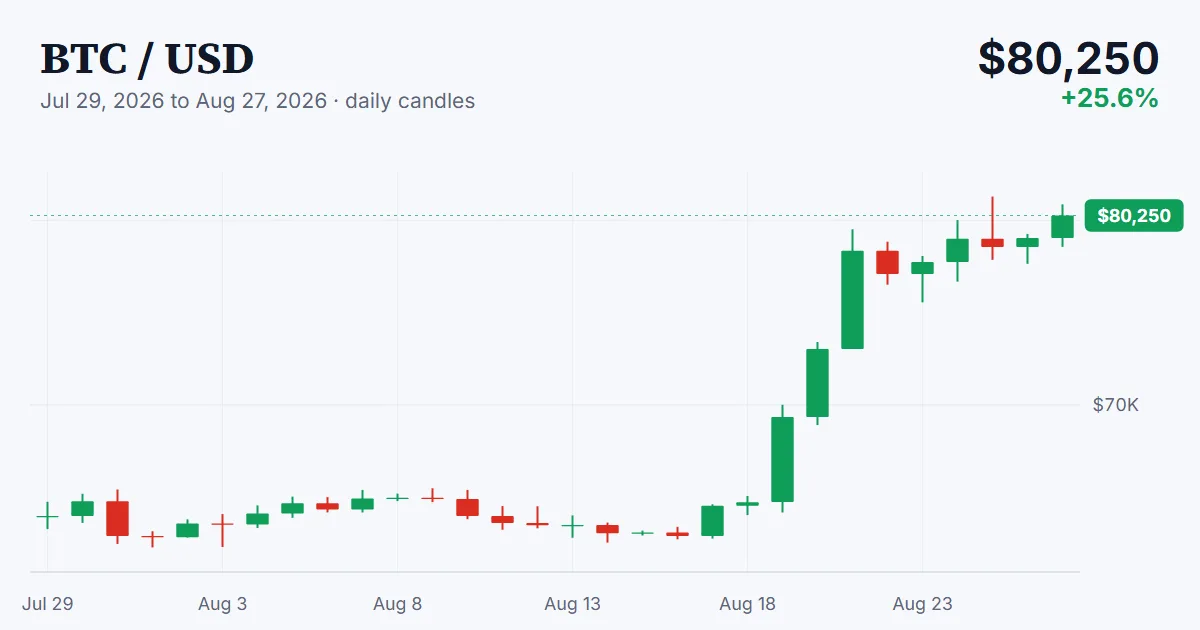
The week's designated risk event finally showed up, and it brought the bad version of itself. The July PCE price index, the Fed's preferred inflation gauge, held at a 3.7 percent annual pace against the 3.6 percent economists expected, with core prices up 0.2 percent on the month, per CBS News. Bitcoin did what the textbook says: it dropped under $78,000 within minutes of the 8:30 a.m. release, per CoinGape and Coinpaper. Then it did what the textbook does not say. By Wednesday's close the price sat at $79,027, up 0.59 percent on the day per The Rio Times, and the loudest chart in crypto belonged to Solana, which ran 5.76 percent to $102.17. A hot inflation print, fully absorbed inside one session, is information about positioning that no calendar could have told you in advance.
The number, the dip, and why the dip did not stick
The mechanical story is short. The print crossed the wire hotter than forecast, algorithms sold, and bitcoin lost the $78,000 handle it had been defending since Tuesday's rejection at $81,265. About $24.42 million in positions were liquidated in the immediate aftermath per CoinGape, roughly $21.5 million of it from longs. Now put that number next to last week's tape: more than $1.4 billion in bearish bets liquidated in a single day as bitcoin first pushed through $80,000, per The Rio Times. The PCE flush was under 2 percent of that. This market has already had its deleveraging event, and what remained on Wednesday was closer to spot supply meeting spot demand than to a leverage cascade looking for a floor.
That is the most honest explanation for the recovery we can offer, and it is worth being precise about what it does not say. A 3.7 percent PCE with core still moving does complicate the friendly-Fed thesis that powered August, and one resilient session does not settle whether $81,000 gets reclaimed or becomes the ceiling the 50-week moving average says it might be. What Wednesday settled is narrower: at current positioning, a mildly hot inflation print is not enough to crack this rally. The sellers it created were absorbed in hours, ETF demand has not shown any sign of turning, and the price ended the day above where the bad news found it. Markets that shrug off their scheduled catalysts tend to be telling you which way the pressure points.
Solana takes the wheel
The more interesting rotation happened below the headline. Solana's 5.76 percent day extends a run that has taken it from $85.37 on August 20 to a weekly high above $102, roughly 20 percent in a week per crypto.news, and for once the move has flows attached rather than just vibes. Spot Solana ETFs collected about $65.74 million in net inflows this week, their strongest week of 2026, and the network side keeps producing numbers that read like a different cycle: a record 4.2 billion on-chain transactions in July and nearly $4 billion in tokenized real-world assets, per the same coverage. Ethereum's 2.58 percent day was respectable; Solana's was a statement, and it came on a session when the macro excuse said risk should be selling off.
Our caution here is the usual one for late-stage catch-up rallies. SOL spent most of the spring lagging the majors, which means part of this move is mean reversion with a good press kit, and a 20 percent week invites exactly the kind of chase that ends badly when the broader market wobbles. The flows are real and the usage is real; the speed is the part to respect.
The listing pipeline did not wait for the Fed
One more thread from a busy Wednesday, because it connects to pages we track. Coinbase took the GRASS-USD pair to full trading on August 26, per Crypto Briefing, walking it through the standard auction and limit-only phases before opening all order types. That completes a five-day sprint from the August 21 roadmap post for the bandwidth DePIN token, and our GRASS listing fiche has flipped from rumored to listed accordingly, with the airdrop side still tracked separately on the Stage 2 page. Of the four tokens in that roadmap batch, only Dolphin now waits on a confirmed pair. A US venue clearing new listings straight through a hot inflation print is its own small data point about risk appetite: the machine that only runs when exchanges expect retail to show up is, for now, still running. Whether that survives a genuine macro scare is a question August has not been forced to answer yet.