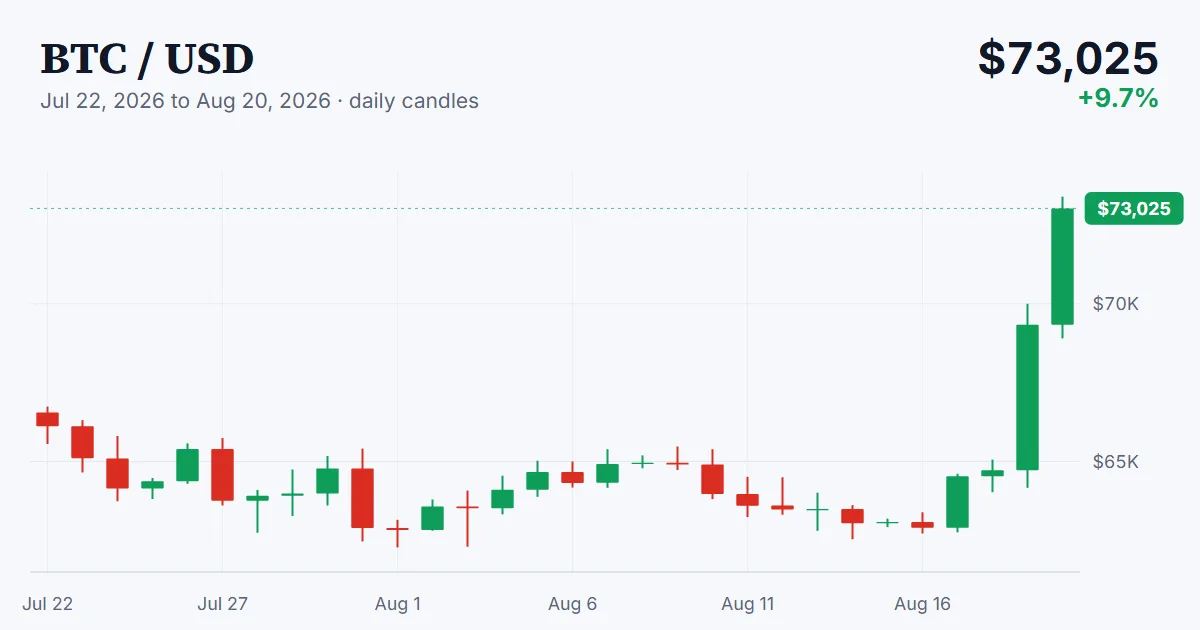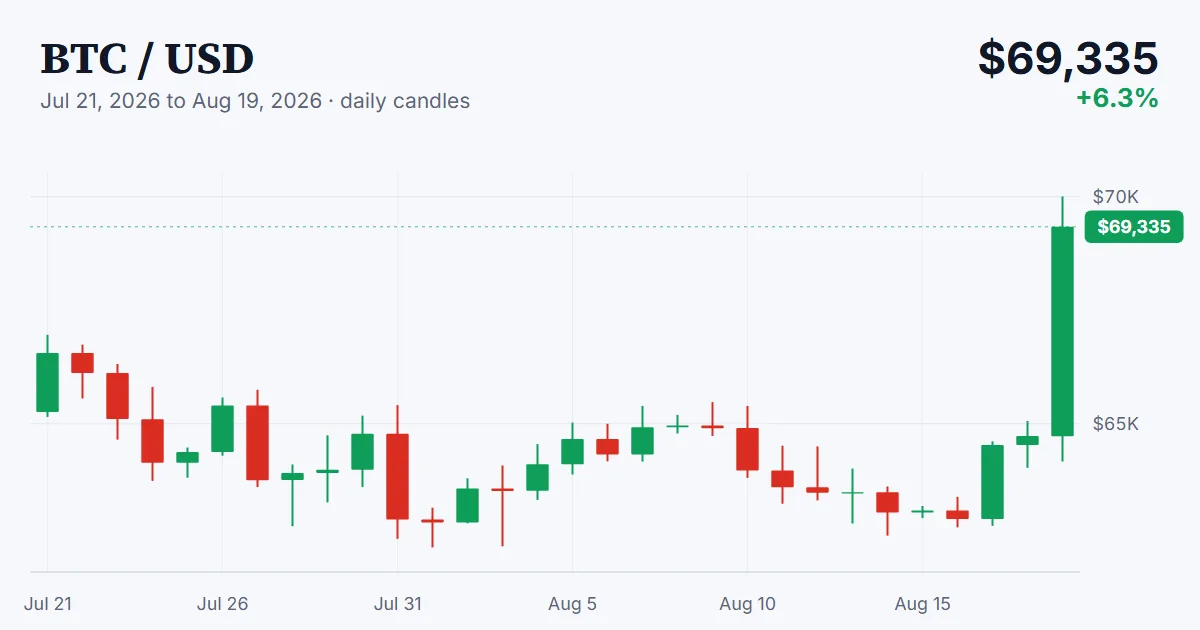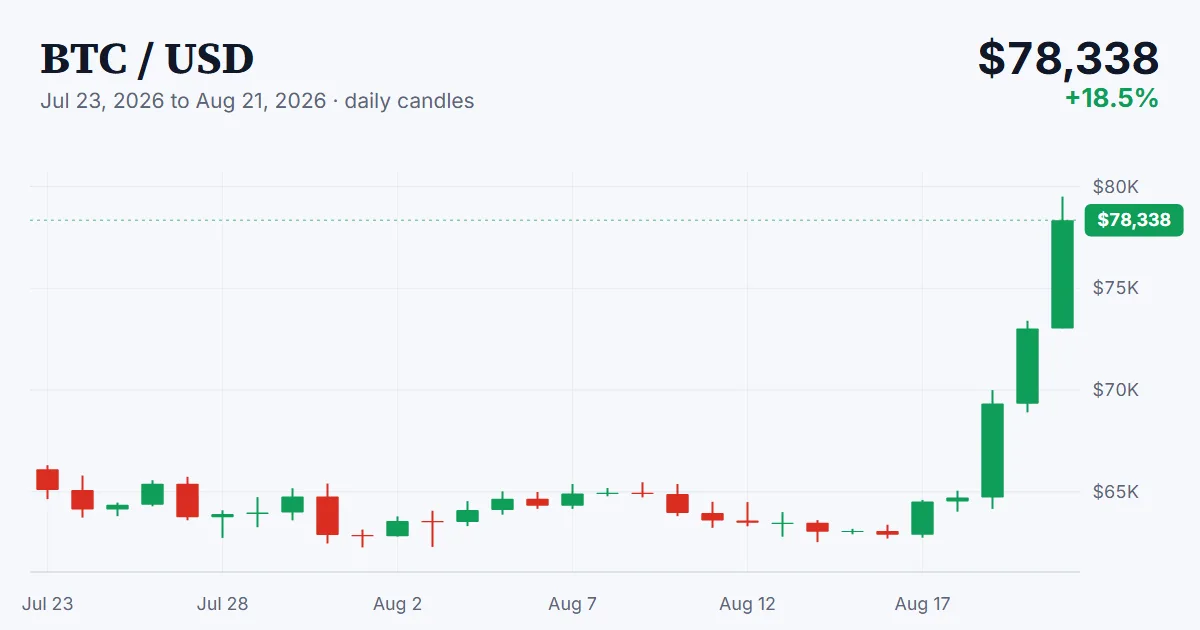
Two days ago this market was stuck in a range everyone had memorized. Now bitcoin has printed $75,560, its highest level in more than three months, and traded near $75,500 again on Friday August 21, per The Block and Blockhead. Ether followed to $2,337, up about 25 percent on the week, and the Fear and Greed Index closed at 72, in greed territory, after sitting at 29 one week earlier, per BeInCrypto. Yesterday we covered the trigger: the Treasury doubling long-end bond buybacks and $1.44 billion in early short liquidations. Today's job is the honest accounting of what kept it going, because the answer is a mix of real buying, real politics, and a very large pile of forced buying that will not repeat.
Start with the forced part. Per The Block, roughly $2.75 billion in bitcoin short positions were liquidated on Wednesday alone, and another $783.2 million followed in the next 24 hours, $747.7 million of that shorts again. Call it three and a half billion dollars of involuntary buy orders in two days. That is not a detail; it is a mechanical accelerant that makes any breakout look stronger than the demand underneath it. Shawn Young of MEXC Research made exactly this case: in his view the market handed the Treasury's intervention far more credit than it deserves, the buybacks opened a pressure valve on long-end yields rather than changing the funding regime, and Treasuries are still competing aggressively for the same capital. His conclusion, per The Block, is blunt: the push above $70,000 looks premature. We do not have to agree fully to take the point that squeezes borrow from future demand.
The buying that was not forced
The counterargument is that real money showed up on cue. Spot bitcoin ETFs took in $517.2 million net on August 19, the largest single day in about three and a half months and a third consecutive day of inflows, per The Block. The composition matters as much as the total: BlackRock's IBIT absorbed $284.7 million, more than half the print, with Ark's ARKB at $77.7 million and Fidelity's FBTC at $62.4 million, per Bloomingbit. Those desks were sellers or absent for most of August, and the weekly tallies we tracked showed money rotating away from bitcoin funds as recently as mid-month. A $517 million day does not erase three weeks of outflows, but it does mean the rally found spot buyers, not just liquidated bears.
The political leg firmed up too. President Trump hosted executives from Coinbase, Ripple, Robinhood, Kraken and ICE at the White House and pressed Congress to pass what he called a fair version of the Clarity Act, per Forbes and CNBC. The two-day gain reached 12 percent around that event, per CNBC. Nothing was actually passed; the Senate's procedural vote is still penciled in for mid-September, and the ethics dispute that stalled the bill before recess has not been resolved. The market is pricing intent, which is worth something, and votes, which are worth more, remain unscheduled work.
What the tape has to prove next
The move itself is easy to summarize in four prints. A $64,100 low on Tuesday, $69,500 by Wednesday morning, $71,834 after the White House event, and $75,560 late Thursday, per The Block, Forbes and crypto.news reporting we cited yesterday. Friday's session holding near $75,500 rather than giving the move back is the first encouraging follow-through signal.
From here the calendar does the talking. Jackson Hole runs August 27 to 29 with Fed Chair Kevin Warsh speaking on the 28th, the expanded Treasury buyback operations actually begin September 9, and the Clarity Act cloture attempt lands mid-September. Each of those can either validate the repricing or expose it as a squeeze that ran ahead of the facts, which is precisely Young's warning. Our own read sits in the middle: the ETF bid returning is the most durable piece of new information this week, the liquidation total is the least, and $66,000, the old range ceiling, is the level that tells us which story wins. A retest that holds it would turn three chaotic days into a floor. Losing it would mean the fine print mattered more than the headline, and we would rather flag that possibility at 72 on the greed index than after it.