Tokenized stocks are having their infrastructure moment. The narrative arrived in waves, first the issuers putting equities onchain, then the exchanges wrapping them in trading products, and now the protocols that want to be the plumbing between all of it. Block Street belongs to that third wave, and on August 7, 2026 it collected the kind of distribution upgrade the category rarely sees: Upbit, South Korea's largest exchange, opened BSB trading across its Korean won, Bitcoin and USDT markets at 3 p.m. local time, the token's first won-denominated venue.
The mechanics followed Upbit's standard playbook for fresh listings. Deposits and withdrawals were initially supported only through the Ethereum network, and the exchange applied temporary trading restrictions, including limit-only orders for roughly the first two hours, to keep the opening auction from turning into a pure momentum race. Three pairs at once is the full treatment; plenty of tokens debut on a single USDT market and wait months for a won pair. As we laid out in the exchange listings guide, that choice is information: Upbit is betting Korean retail wants direct won exposure to the tokenized equities theme, not just a crypto-settled proxy.
The protocol behind the ticker
Block Street pitches itself as infrastructure for onchain capital markets, with tokenized equities and real-world assets as the target inventory. The core design is what the project calls a Unified Liquidity Layer, an attempt to stitch together liquidity that currently sits fragmented across issuers, blockchains and trading venues, so that a tokenized share can be borrowed against, margined, hedged or arbitraged rather than just held. If that sounds familiar, it is the same thesis driving Plume's RWA chain from the network side; Block Street attacks it from the market-structure side.
The project is not arriving unfunded or unknown. It closed an $11.5 million strategic round in October 2025 led by Hack VC, with Generative Venture, DWF Labs, StudioB and Bridge34 participating, and the token already traded on offshore venues before the Korean debut, including Bybit, with Binance running a BSB trading rewards campaign on its own platform. The Upbit listing does not introduce BSB to the market so much as it introduces BSB to Korea, historically the retail audience most willing to reprice a token overnight when a theme catches.
- Circulating at TGE (207.75M) 20.8%
- Locked and future unlocks (792.25M) 79.2%
The supply column is the whole caveat
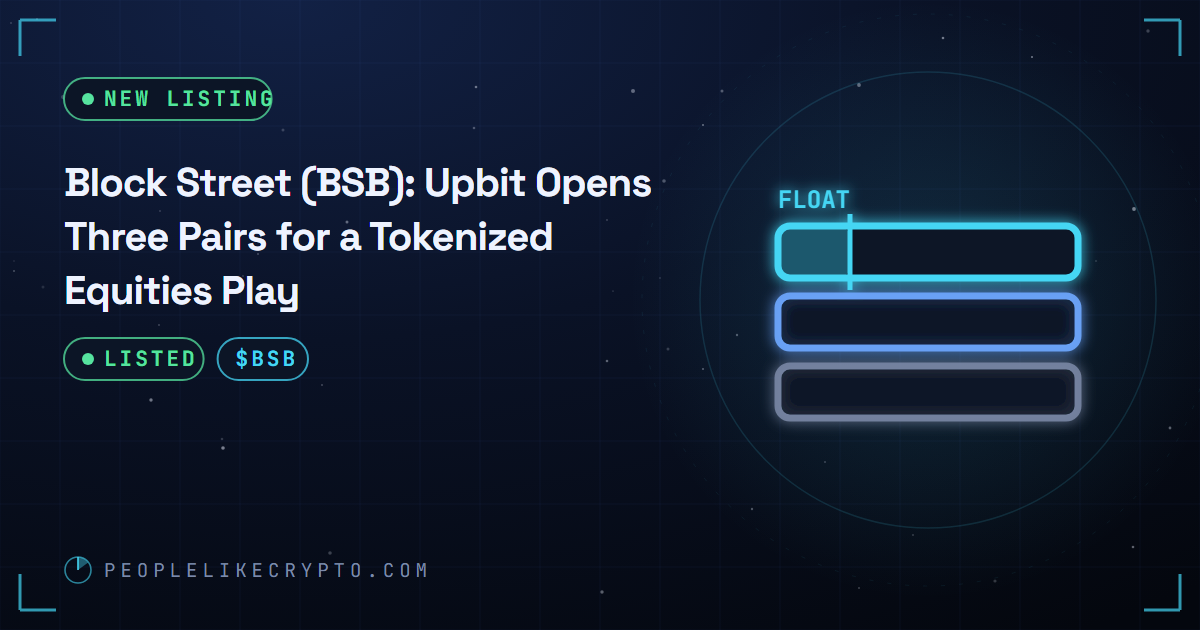
The whitepaper fixes total supply at 1 billion BSB, with 207.75 million tokens, about 20.775 percent, expected to circulate around the token generation event. Read that number the way we always suggest: roughly four fifths of the supply is not on the market yet, and every future unlock is a scheduled seller meeting whatever demand the narrative has generated by then. A won listing widens the buyer pool today; it does nothing about the token schedule tomorrow. Our tokenomics guide covers how to weigh a float this size against a listing pop, and the short version is that thin floats amplify both directions.
The theme, at least, has real fundamentals moving underneath it. Exchanges keep expanding tokenized stock offerings, issuers keep adding names, and the regulatory conversation in Washington treats tokenized securities as a matter of when and how rather than whether. A protocol positioned as neutral plumbing for that flow is a rational thing for a major exchange to list, and Korea has been early on every prior market-structure theme, from DeFi derivatives to modular chains. Whether BSB the token captures the value of Block Street the thesis depends on mechanics the whitepaper sketches and the market has not yet stress-tested. As of our August 8 check the token trades on Upbit's three new pairs with Ethereum deposits enabled, and the fiche will track venue additions and any supply schedule changes as they publish.
Not financial advice Listings often spike and then bleed once the initial hype unwinds. Nothing here is a suggestion to buy this token. Verify dates on the exchange's own announcement page before trading: schedules slip.