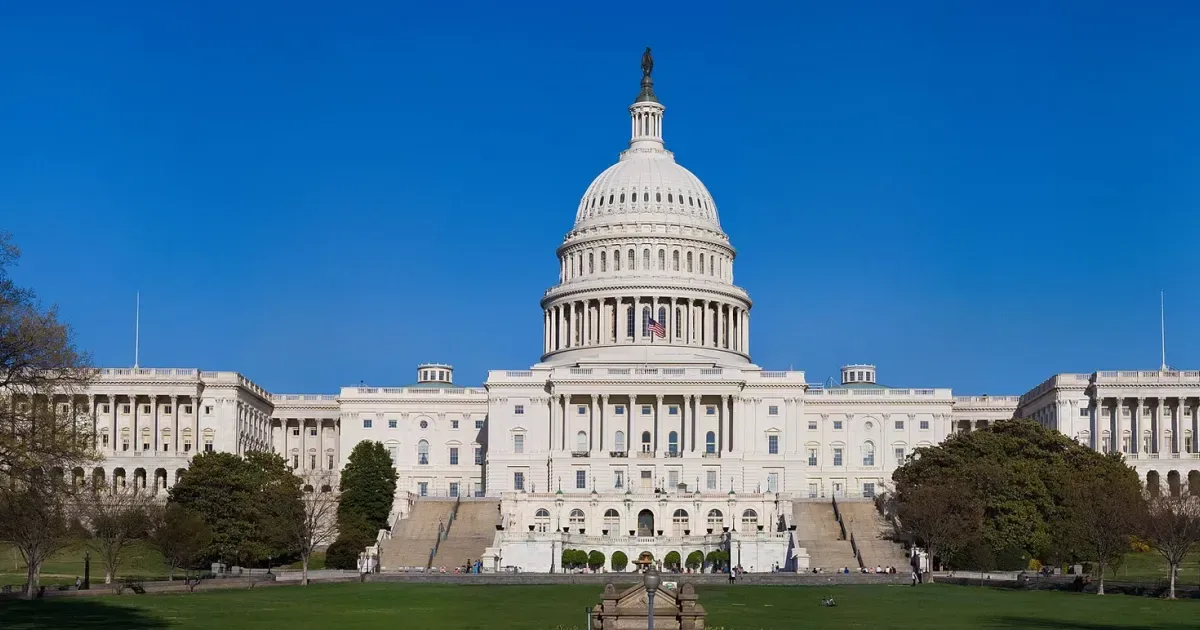
The CLARITY Act, formally the Digital Asset Market Clarity Act (H.R. 3633), would write into US law who regulates crypto markets and how tokens are sorted. The House passed it 294 to 134 on July 17, 2025. On September 15, 2026, a Senate vote to start debate failed 49 to 50, short of the 60 votes required.
Two texts exist, and they differ: the bill the House passed in 2025 and the substitute the Senate Banking Committee reported on June 1, 2026. This guide covers both, the disputes that stalled the bill and what the official record shows as of October 7, 2026. It describes what the texts say and makes no forecast.
What the bill would change
The bill would put a sorting test for tokens into statute. Supporters want written rules in place of case-by-case enforcement.
The House text defines a "digital commodity" as a digital asset tied to a blockchain system, whose value comes from use of that system. It lists examples: assets the system creates itself, assets used to pay fees or vote on governance, and rewards paid to validators. It excludes securities that carry ownership, profit or debt claims.
A token can still start life in a securities sale. The House text calls a digital commodity sold under an investment contract an "investment contract asset". Under that label the token itself is not the investment contract, although the sale can be. The SEC keeps authority over that first sale.
For small raises, the House text adds an exemption from registration. An issuer could raise up to $50 million in 12 months, adjusted yearly for inflation. No buyer could end up holding more than 10 percent of the supply. The issuer would also have to certify its blockchain as a "mature blockchain system", or intend to, within four years.
The Senate Banking Committee struck the House language and substituted its own, with different terms. A "network token" is a digital commodity tied to a ledger system and treated as a non-security under the securities laws. An "ancillary asset" is a network token whose value depends on the efforts of a company or its related persons. Those originators face disclosure duties.
The Senate text also sets a "gratuitous distribution" apart from investment contract treatment. That means tokens handed out for no more than a nominal value, in a broad, equitable and non-discretionary way. Its examples include staking rewards and automated, rules-based distributions. Neither bill text uses the word "airdrop". In our reading, this carve-out is the closest provision to how many airdrops work, but the text does not say so.
Beyond token classification, the Senate substitute runs to nine titles. They cover illicit finance, DeFi, banking activity, regulatory sandboxes, protections for software developers, customer property in bankruptcy and customer education. Market structure is one part of a broad package, which is why changes to any single section move votes elsewhere.
Who would regulate what
The House version splits the work between two agencies. Under it, the CFTC gets exclusive jurisdiction over spot trading in digital commodities on registered venues and by registered firms, with carve-outs for bank custody and for securities sales. The SEC keeps offers and sales made under investment contracts, plus the disclosure rules attached to them.
| Body | Role under the bill | Where in the text |
|---|---|---|
| SEC | Offers and sales of investment contracts involving digital commodities, with disclosure and exemption rules; in the Senate text, disclosure duties for ancillary assets | House Titles II and III; Senate Title I |
| CFTC | Exclusive jurisdiction over spot digital commodity trading on or subject to the rules of registered entities; registration of digital commodity exchanges, brokers and dealers | House Sec. 401 and Secs. 404 to 406 |
| SEC, CFTC and Treasury together | Joint rules, due within one year of enactment, on which stablecoin rewards stay allowed | Senate Sec. 404 |
| Bank regulators | May not require capital against crypto that banks hold in custody for customers, except to cover operational risk | House Sec. 310 |
The Senate Banking text we read covers the SEC side and the shared rules. It has no chapters registering exchanges and brokers with the CFTC. Our August report on the Senate recess noted that the Agriculture Committee's share of the jurisdiction question was unresolved.
The Senate text also tells the two agencies to build a joint "micro-innovation sandbox" within 360 days of enactment. It would let eligible firms test new products under limits, while existing securities and commodities laws still apply.
The three disputes that stalled it
Stablecoin yield. Section 404 of the Senate Banking text bars digital asset service providers from paying US customers interest or yield for holding payment stablecoins. It also bars payments that work like bank deposit interest. Rewards tied to bona fide activity stay allowed, such as payments, supplying liquidity, putting assets at risk or staking. CoinDesk reported on September 21 that banks see yield-bearing stablecoins as competition for deposits. White House adviser Patrick Witt said on September 23 that bank lobbying helped sink the bill.
DeFi and developers. The House text would keep people out of Exchange Act coverage for writing software, running nodes, operating liquidity pools or providing wallet tools for a DeFi trading protocol. Fraud and manipulation rules would still apply. The Senate text keeps similar protections in Sections 601 and 604. Section 604 says a developer who cannot unilaterally control users' funds is not a money transmitter.
Section 301 of the Senate text adds rules for "non-decentralized finance trading protocols", where a person or group can change the rules or restrict users. Where a protocol sits on that line decides which securities and anti-money-laundering duties apply.
Ethics. The Senate Banking text we read has no ethics section. Provisions to limit senior officials' crypto business ties were negotiated separately. CoinDesk reported on September 15 that the ethics sections were among the last parts where the parties could not agree. Witt said the president had accepted two ethics provisions, including divesting crypto or placing it in a blind trust, and that Democrats had made the issue political.
Where the bill stands today
The dates below come from Congress.gov data published through GovInfo, last updated September 17, 2026, and from the House roll call. Our August report on the recess predates the vote.
294 to 134. 216 Republicans and 78 Democrats yes, 134 Democrats no.
Committee ordered it reported with a substitute on May 14.
Motion to proceed made and cloture presented.
49 to 50, roll call 234. Sixty votes were needed.
Before the House floor vote, two House committees ordered the bill reported on June 10, 2025, by 32 to 19 and 47 to 6. The Senate received it on September 18, 2025 and sent it to the Banking Committee. After that committee reported its substitute, the bill sat on the Senate calendar as No. 423 until the August 8 motion.
On September 15, cloture on the motion to proceed failed 49 to 50. Cloture is the vote that ends debate, and the motion to proceed is the step that brings a bill to the floor. CoinDesk reported that all Senate Democrats and some Republicans opposed it, and that shares of Coinbase and Circle fell about 10 percent in the aftermath. The same day, Senator Tillis entered a motion to reconsider the vote.
The status data lists no action after September 15. We found no report of a second vote in CoinDesk's coverage through October 5. On October 4, CoinDesk wrote that Congress was out of session for the final recess before the November 3 midterm elections. It had written on September 15 that any revival would take long-odds maneuvers in the final weeks of the session after the election.
The agencies are moving meanwhile. On October 5 the CFTC proposed two rules, Regulation CTX and Regulation CAM, with a 60-day comment period. They cover leveraged, margined or financed crypto trades and a new type of exchange registration. CoinDesk noted a gap: the CFTC still lacks authority over plain spot trading, which the House text would grant. Atkins has said agency rules and exemptions will not last without a law under them, CoinDesk reported.
What to watch, each item checkable:
- November 3. The midterm elections decide who controls the next Congress.
- The post-election session. Senate leaders could bring the bill back, for example through the pending motion to reconsider.
- New text. A version that adds ethics language would close the last open gap in the talks.
- The CFTC comment period. The 60-day window on Regulation CTX and Regulation CAM will show how the agency answers the spot-market gap.
What it means for tokens you hold or farm
Without the bill, no statute settles whether a given token is a security or a commodity. In our reading, that leaves US exchange listings and US access to new token launches dependent on each company's own legal view and on agency rules. Our June explainer covers how the earlier delay held back US-facing launches.
The bill is a market-structure bill, not a tax bill. Tax on airdrops follows separate rules, which our airdrop tax guide sets out country by country. For the basics of how drops work, see our airdrop explainer.