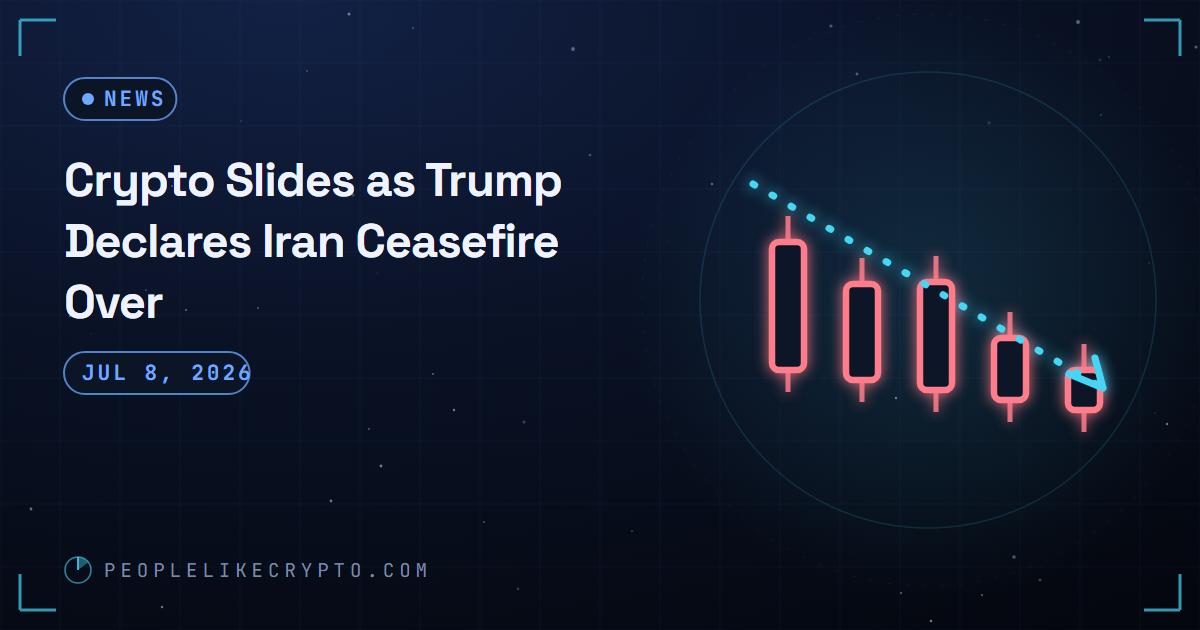
Crypto spent the first half of the week clawing back June's losses. Geopolitics took the winnings back in a single morning. Bitcoin fell more than 2 percent to about $61,750 on Wednesday, July 8, and ether dropped in step to the $1,730 area, after President Trump told NATO leaders the ceasefire with Iran was over and called further negotiation a waste of time, per CoinDesk. The CoinDesk 20 index, a broad basket of large-cap tokens, was down 2.9 percent since midnight UTC.
The trigger was military, not monetary. US Central Command said it struck more than 60 Islamic Revolutionary Guard Corps small boats in the Strait of Hormuz to keep international shipping lanes open, and Iran answered with attacks on Kuwait and Bahrain. Oil jumped, US equity futures fell, and every risk asset on the board, crypto included, repriced for the possibility of a wider conflict rather than the contained one the market had penciled in.

Why a strait most traders ignore moves bitcoin
The Strait of Hormuz is a narrow chokepoint through which roughly a fifth of the world's oil supply flows. When shipping through it is threatened, the oil price rises, and a higher oil price feeds straight into inflation expectations. That is the link back to crypto. For two years this market has traded on a single question: when do interest rates come down? Anything that lifts inflation pushes that answer further out, and higher-for-longer rates make the safe yield on bonds more attractive relative to assets that pay nothing and swing hard, which is the textbook description of bitcoin.
You could see the mechanism working across every screen on Wednesday. The Dollar Index rose as traders reached for the reserve currency, Nasdaq 100 and S&P 500 futures slid as much as 1.5 percent, and bitcoin fell with them rather than against them. That last detail matters. The comforting story that bitcoin is digital gold, a haven that catches a bid when the world gets dangerous, did not survive contact with an actual escalation. On the day it was tested, bitcoin was a high-beta risk asset, and it behaved like one.
Altcoins wore the losses
Risk-off days are rarely democratic, and this one was no exception. Of roughly $450 million in liquidations over 24 hours, about $350 million came from altcoin positions, against $100 million in bitcoin and $90 million in ether. The pattern is the one leverage always produces: the assets furthest out the risk curve fall hardest when the curve gets shorter. JUP, ETHFI and PUMP each lost between 5.5 and 9.3 percent, and Solana gave back its entire July rally to trade near $77 after challenging $84 on Monday.
For anyone farming the launch calendar, that Solana move is worth sitting with. Tokens still in their distribution window, the sort we track on the airdrops page, inherit their chain's volatility and then add their own. JUP, one of the day's biggest losers, is the token behind Jupiter, whose postponed Jupuary program we cover in detail. A weak tape is exactly when supply-heavy tokens struggle most, because there is no fresh demand to absorb whatever unlocks or sells into it. The honest takeaway is not to panic but to size for it: a portfolio built around dateless, high-beta token bets is a leveraged position on the calmest possible macro backdrop, and Wednesday was a reminder that the backdrop does not stay calm on request.
Geopolitics jumps the macro queue
We spent last weekend mapping July around two events: the June CPI print on July 14 and the Federal Reserve meeting on July 28 and 29, the schedule we laid out in our July pivot piece. A single morning rearranged that queue. Neither the inflation data nor the Fed changed, but a variable that outranks both of them walked in the door, and the market dropped everything to price it.
That is the real lesson of the day, and it cuts in both directions. Headline-driven moves round-trip fast when the headline softens: Monday's $63,900 high to Wednesday's $61,750 is the kind of swing that can reverse on a single conciliatory sentence from either capital. They also compound fast when the headline hardens, and nobody trading can know in advance which way the next 48 hours break. The signals worth watching now are not on the economic calendar at all: whether shipping resumes through the strait, where oil settles, and whether the language coming out of Washington and Tehran cools or escalates. None of this is financial advice, and the only position that reads the same in both scenarios is one sized to survive the version you did not expect.